
CouchSetup is reader-supported. When you buy through links on our site, we may earn an affiliate commission at no extra cost to you. Learn more
The best outdoor projector is bright enough for the screen you want, lasts the whole movie, and is loud enough for open air, where there are no walls to help the sound. Most backyard movie nights that go wrong fail on one of those three: a washed-out picture, a battery that dies before the credits, or dialogue that disappears when a car drives past.
Our verdict
Quick picks: the Nebula X1 for a big, bright 4K picture if you can run power to it. The Hisense C2 Ultra is just as bright, with JBL sound and a zoom that makes placement easy. The XGIMI MoGo 4 is the easiest battery projector to carry. On a budget, the Epson EpiqVision Flex CO-FH02 gives the most brightness if you have an outlet, and the Nebula Mars 3 Air is the cheapest good battery pick.
Top picks at a glance
Best overall
Nebula X1
Big backyard screens and buyers who want one projector for indoors and out
$$$ PremiumBest for flexible placement
Hisense C2 Ultra
Yards where the projector cannot sit at one exact distance, and big-screen gaming
$$$ PremiumBest compact
XGIMI MoGo 4
Small patios, balconies and quick weeknight movies
$$ Mid-rangeThe five picks side by side
| Projector | Rated brightness | Resolution | Battery | Best for | Price |
|---|---|---|---|---|---|
| Nebula X1 | 3,500 ANSI lumens | 4K UHD | None (plug-in) | Big, bright backyard screens | $$$Check price |
| Hisense C2 Ultra | 3,000 ANSI lumens | 4K UHD | None (plug-in) | Flexible placement, big sound | $$$Check price |
| XGIMI MoGo 4 | 450 ISO lumens | 1080p | Up to 2.5 hours (Eco) | Small patios and travel | $$Check price |
| Epson EpiqVision Flex CO-FH02 | 3,000 lumens | 1080p | None (plug-in) | Most brightness on a budget | $Check price |
| Nebula Mars 3 Air | 400 ANSI lumens | 1080p | Up to 2.5 hours (Eco) | Cheapest battery option | $Check price |
What the reviews don’t tell you
Each review tests one projector. Lining up the claims next to what reviewers actually measured shows a few things worth knowing before you buy.
Battery claims are for a dimmer mode
| Projector | Maker’s claim | What reviewers got |
|---|---|---|
| XGIMI MoGo 4 | Up to 2.5 hours (Eco) | 1 hour 52 minutes streaming in Standard (Expert Reviews) |
| Nebula Mars 3 | Up to 5 hours (Eco, 300 lumens) | A little over 2 hours (TechRadar); Nebula itself lists about 2 hours in Standard |
| TCL PlayCube | Up to 3 hours | About 2.5 to 3 hours (TechRadar) |
The pattern is the same every time: the headline run time is in a dimmed Eco mode. At normal brightness, plan on roughly two hours. That covers most films, but not a long one, so for anything over two hours start fully charged and bring a power bank or a cord.
Two labs, two numbers for the same projector
Projector Central measured the Nebula X1 at 3,187 ANSI lumens in its brightest mode. Tom’s Guide measured 3,491, almost exactly the 3,500 rating. Both are respected testers, so the gap is a useful reminder: units vary, and the brightest mode is rarely the one with the best color. Projector Central got about 2,588 lumens in the brightest mode that still looked accurate.
Screen size is a bigger lever than the projector
Doubling the screen area halves the brightness you see. Using Elite Screens’ formula (lumens divided by screen area), here is roughly what each size needs:
| 16:9 screen | Lumens for full dark | Lumens for dusk or porch lights |
|---|---|---|
| 80 inches | About 300 | About 950 |
| 100 inches | About 475 | About 1,480 |
| 120 inches | About 680 | About 2,140 |
| 150 inches | About 1,070 | About 3,340 |
So a 400-lumen battery projector really is a full-dark, 80 to 100-inch projector, which matches What Hi-Fi’s advice of 70 to 90 inches for the Mars 3 Air. If you want 150 inches or want to start before it’s fully dark, you need one of the 3,000-lumen plug-in models.
The picks
1. Nebula X1: best overall
Nebula X1
Best for Big backyard screens and buyers who want one projector for indoors and out
- 3,500 ANSI lumens, triple-laser light source
- 4K UHD with Dolby Vision and HDR10 support
- 40 W built-in speakers, optional wireless satellites
- Motorized gimbal, Google TV, two HDMI inputs
- 13.7 lb with built-in handle; AC power only
Prices change often, so check today’s price on Amazon.
The X1 is one of the few projectors designed for the backyard first. It has a carry handle, a motorized gimbal that tilts and lines up the picture on its own, quiet liquid cooling, and 40 watts of built-in speakers. RTINGS currently names it its top outdoor projector, and Projector Central said even the built-in speakers are impressive before you add Nebula’s optional wireless satellites.
The catch: it’s expensive, it weighs 13.7 pounds, there’s no battery, and Projector Central says it looks best with the screen shaded rather than in direct light.
2. Hisense C2 Ultra: best for flexible placement
Hisense C2 Ultra
Best for Yards where the projector cannot sit at one exact distance, and big-screen gaming
- 3,000 ANSI lumens, laser light source
- Native 4K with Dolby Vision
- JBL 2.1 sound: 2 x 10 W plus 20 W subwoofer
- 0.9 to 1.5:1 throw range, 65 to 300 inch images
- Gimbal stand; 13.9 lb, AC power only
Prices change often, so check today’s price on Amazon.
TechRadar ranks the C2 Ultra its best portable projector overall. Its real backyard advantage is the zoom: a 0.9 to 1.5:1 throw range means the table doesn’t have to sit at one exact spot to fill your screen. The JBL 2.1 system, with its own subwoofer, also gives more bass than most portables manage outside.
The catch: it’s 13.9 pounds, needs AC power, and runs Hisense’s VIDAA system rather than Google TV, so check your apps or add a streaming stick.
3. XGIMI MoGo 4: best compact projector
XGIMI MoGo 4
Best for Small patios, balconies and quick weeknight movies
- 450 ISO lumens, 1080p
- Up to 2.5 hours video in Eco mode
- Dual 6 W Harman Kardon speakers
- Google TV with licensed Netflix
- 2.9 lb, 1.2:1 throw ratio, 360-degree stand
Prices change often, so check today’s price on Amazon.
This is the small cylinder you’ll actually bring outside on a weeknight. It weighs 2.9 pounds, runs Google TV with a proper Netflix app, and its Harman Kardon speakers sound fuller than its predecessor, according to TechRadar. An optional PowerBase stand roughly doubles the battery.
The catch: 450 lumens means waiting for full dark and staying around 60 to 100 inches, black levels are weak, and the real battery life at normal brightness is closer to two hours.
4. Epson EpiqVision Flex CO-FH02: best budget pick for big screens
Epson EpiqVision Flex CO-FH02
Best for Big backyard screens on a budget, with an outlet nearby
- 3,000 lumens color and white brightness
- 1080p 3LCD, images up to 300 inches
- Android TV with Chromecast built-in
- Bluetooth audio out to a speaker
- 5.7 lb, 1.19:1 throw ratio
Prices change often, so check today’s price on Amazon.
If you can reach an outlet, nothing here gives you more brightness for the money. It’s rated at 3,000 lumens and projects up to 300 inches, and a 100-inch picture needs the lens about 8 feet 8 inches from the screen.
The catch: it uses a lamp rather than LED or laser, there’s no battery, and the 5 W speaker isn’t enough outside, so plan on a Bluetooth speaker.
5. Nebula Mars 3 Air: best cheap battery pick
Nebula Mars 3 Air
Best for First-time buyers and small yards
- 400 ANSI lumens, 1080p
- Up to 2.5 hours video, 8 hours music
- Google TV with native Netflix
- Two 8 W speakers
- 3.7 lb, 1.2:1 throw ratio
Prices change often, so check today’s price on Amazon.
The cheapest cordless 1080p projector with Google TV in this guide. What Hi-Fi gave it 4 stars for its sharp, saturated picture, sturdy build and native Netflix app.
The catch: 400 lumens needs real darkness and a modest screen, and What Hi-Fi noted inconsistent app support and grayer shadows in HDR.
Want a brighter battery projector?
The Nebula Mars 3 is TechRadar’s top portable projector for outdoors. It’s rated at 1,000 ANSI lumens with a 40 W speaker and IPX3 splash resistance, but it weighs 9.9 pounds and its sound is mono. The TCL PlayCube is a lighter 750-lumen option with a weak 5 W speaker.
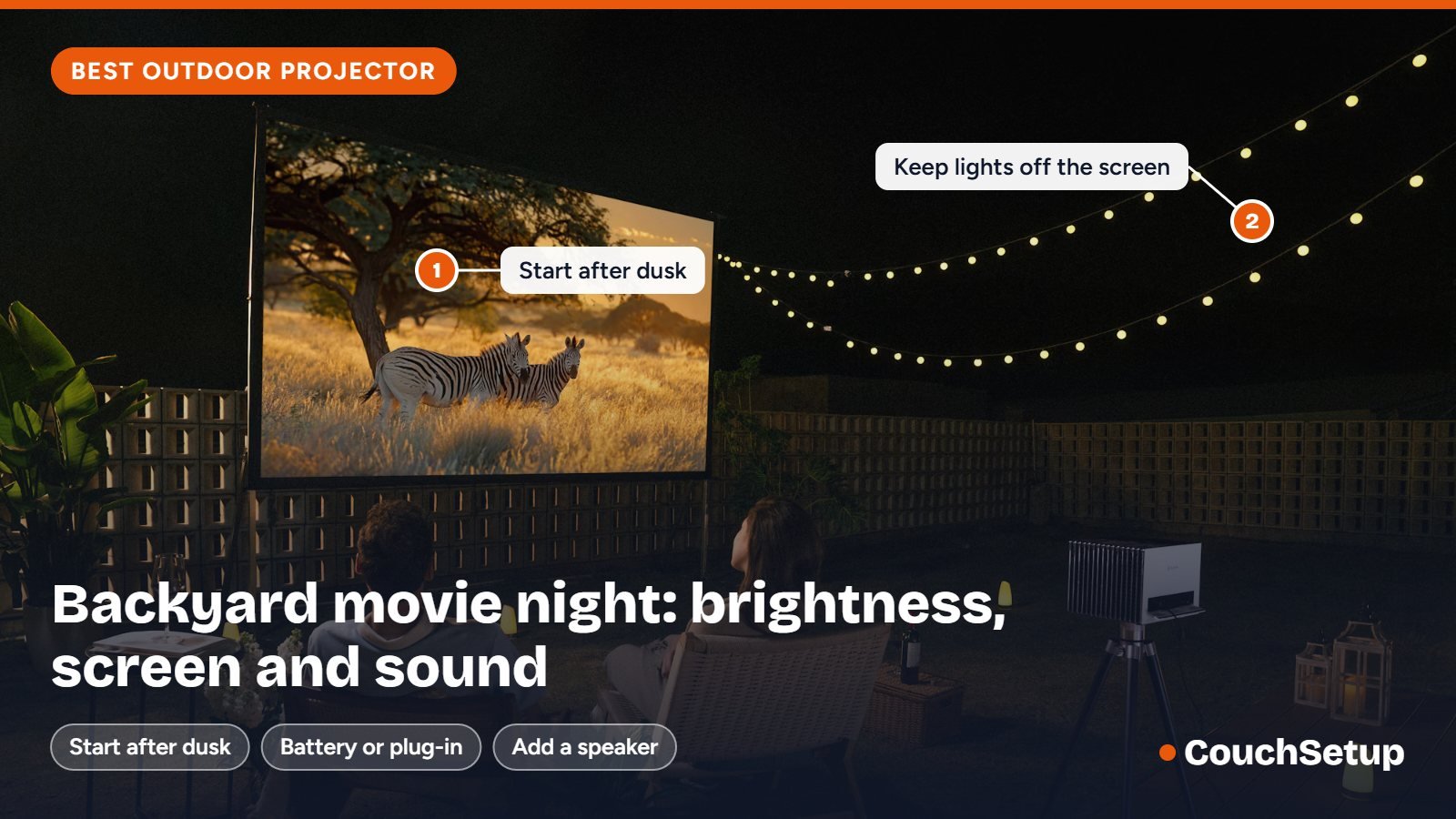
Don’t forget the screen
A smooth light wall or a tight sheet works to start, but wrinkles and texture show up in the picture. A framed portable screen with stakes and ropes is the single best upgrade for any backyard setup. More options in our best projector screens guide.
Elite Screens Yard Master 2
Best for Backyard movie nights where the screen comes down after use
- Aluminum frame, tool-free assembly
- Legs, stakes and ropes included
- 1.3-gain CineWhite UHD-B surface
- Folds into a carry bag
Prices change often, so check today’s price on Amazon.
When to start the movie
Even a bright projector looks faded while the sky is still glowing. Wait until the end of civil twilight, when the sun is 6 degrees below the horizon. Timeanddate puts that around 28 minutes after sunset in New York at the equinox, so in most of the US, plan on about half an hour. Look up “civil dusk” for your zip code and run trailers until then.
Backyard setup checklist
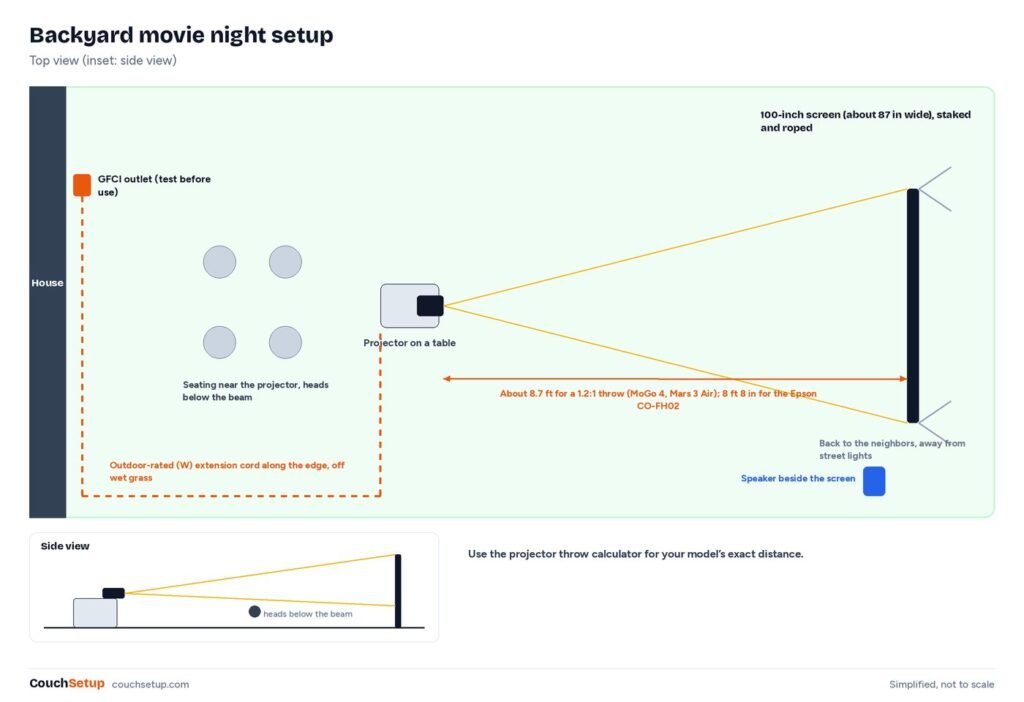
- Set up 30 to 60 minutes before civil dusk, while you can still see.
- Put the screen with its back to the street, porch lights and neighbors. Stake it and add ropes if there’s wind.
- Place the projector at the right distance for your screen. Our projector throw calculator does the math.
- Plug into a GFCI-protected outdoor outlet and use a cord marked for outdoor use (a “W” on the jacket). Route it along edges, not across walkways.
- Put the speaker next to the screen so voices come from the picture.
- Seat people low, on blankets or low chairs, so heads stay out of the beam.
Built-in speakers are fine for a few people sitting close. For a bigger group, or with a 5 W speaker like the Epson’s, add a speaker by the screen. Our soundbars under $300 list covers affordable options.
None of our five picks lists a water-resistance rating for the projector itself, so bring it inside if it drizzles and as soon as the movie ends, before dew settles.
How we picked
We gathered the measurements and expert reviews for every pick, put them side by side, and worked out the room-fit numbers the individual reviews leave out. For projectors that meant measured brightness against the box claims, real battery life and built-in sound. Every source is listed at the end.
FAQ
How many lumens do I need for an outdoor projector?
For a 100-inch screen in full darkness, about 500 real ANSI lumens. To start at dusk or go bigger, 1,500 to 3,000. Only compare ANSI or ISO lumens; “LED lumens” and “lux” on cheap listings aren’t comparable.
Can you use an outdoor projector during the day?
Not well. Even 3,000-lumen projectors look washed out in daylight. Start after civil twilight ends, roughly 20 to 45 minutes after sunset depending on where you live.
How long do battery outdoor projectors last?
Most claim 2.5 to 3 hours, but that’s in a dimmer Eco mode. At normal brightness expect about two hours, so bring a power bank for long movies.
Are outdoor projectors waterproof?
Almost none are. The Nebula Mars 3 is rated IPX3 for light splashes, not rain. Bring any projector inside if it rains and before dew settles.
Can I use a bedsheet as a screen?
Yes. Pull a white sheet tight over a frame or between two posts so it doesn’t ripple, and block light from behind. A real screen looks flatter and brighter.
Related guides
Sources: Projector Central: Nebula X1 review · Tom’s Guide: Nebula X1 review · RTINGS: best outdoor projectors · TechRadar: best portable projectors · B&H: Hisense C2 Ultra specs · Expert Reviews: XGIMI MoGo 4 review · What Hi-Fi?: Nebula Mars 3 Air · Projector Central: Epson CO-FH02 · Nebula: Mars 3 specs · TechRadar: TCL PlayCube review · Elite Screens: lumens and foot-lamberts · Timeanddate: civil twilight