

CouchSetup is reader-supported. When you buy through links on our site, we may earn an affiliate commission at no extra cost to you. Learn more
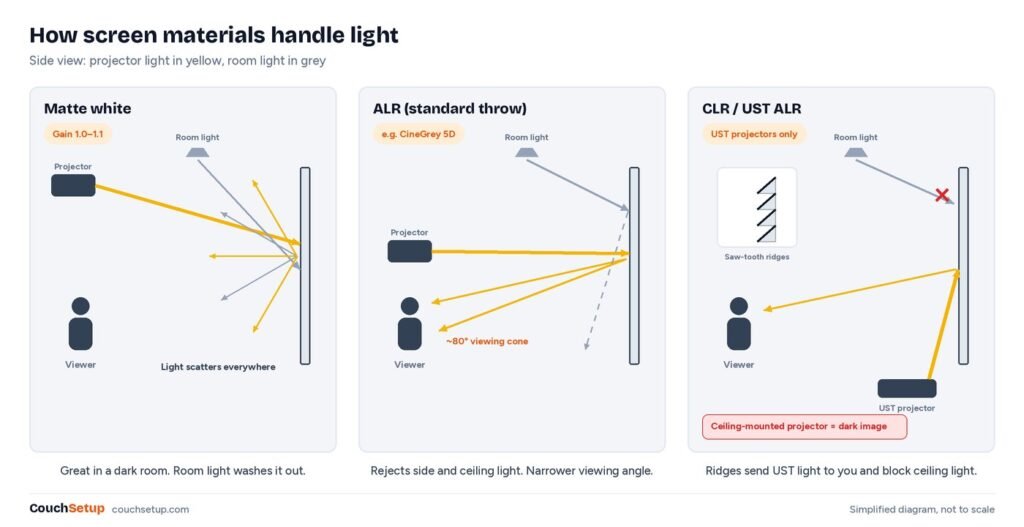
The right screen is the one matched to your projector and your room, not the priciest one. In a dark room a budget matte white screen can beat a premium light-rejecting one, and a ceiling-light-rejecting screen paired with the wrong projector looks dim and patchy whatever it cost.
Our verdict
Quick picks: for a dark room, the Silver Ticket STR is the best projector screen for the money. For a bright living room with a ceiling or shelf projector, the Elite Aeon CineGrey 5D. For an ultra-short-throw projector, a CLR screen like the Elite Aeon CLR 3. Need it to disappear? The Elite Manual pull-down, Spectrum motorized or Vividstorm S Pro Plus floor-rising screen.
Top picks at a glance
Best value
Silver Ticket STR Fixed Frame Screen
Dark rooms, basements and dedicated theaters on a budget
$ BudgetBest ALR for standard throw
Elite Screens Aeon CineGrey 5D
Bright living rooms with a ceiling- or shelf-mounted projector
$$ Mid-rangeBudget CLR for short throw
Akia Screens Edge Free CLR2
Tabletop short-throw projectors in rooms with ceiling lights
$$ Mid-rangeThe eight picks side by side
| Screen | Type | Gain | Works with | Best for | Price |
|---|---|---|---|---|---|
| Silver Ticket STR | Fixed frame | 1.1 matte white | Standard and short throw | Dark rooms, best value | $Check price |
| Elite Aeon CineGrey 5D | Fixed frame | 1.5 grey ALR | Standard throw only | Bright living rooms | $$Check price |
| Akia Edge Free CLR2 | Fixed frame | 0.9 CLR | UST and tabletop short throw | Tabletop short-throws | $$Check price |
| Elite Aeon CLR 3 | Fixed frame | 0.8 CLR | UST only | Bright rooms with a laser TV | $$$Check price |
| Vividstorm S Pro Plus | Floor-rising | 0.6 grey ALR | UST only | No free wall | $$$Check price |
| Elite Spectrum | Motorized roll-down | 1.1 white | Standard throw only | Screens that hide | $$Check price |
| Elite Manual | Pull-down | 1.1 white | Standard throw only | Tight budgets | $Check price |
| Elite Yard Master 2 | Portable | 1.3 white | All throw types | Backyard nights | $Check price |
What the reviews don’t tell you
Screen reviews rate each screen with whatever projector the reviewer had. But gain and size change how bright the picture is, and that’s easy to work out. Foot-lamberts (ftL) are lumens divided by screen area in square feet, times gain. Here’s one projector putting out 2,000 real lumens on different screens:
| Screen | Size | Gain | Picture brightness | Price |
|---|---|---|---|---|
| Matte white (Silver Ticket STR) | 100 in | 1.1 | about 74 ftL | $Check price |
| Matte white (Silver Ticket STR) | 120 in | 1.1 | about 52 ftL | $Check price |
| Grey ALR (CineGrey 5D) | 120 in | 1.5 | about 70 ftL | – |
| CLR (Aeon CLR 3) | 123 in | 0.8 | about 36 ftL | – |
| UST ALR (Vividstorm) | 120 in | 0.6 | about 28 ftL | – |
Two things fall out of this. Going from 100 to 120 inches costs about 30% of your brightness on the same screen. And low-gain CLR and UST screens look much dimmer on paper, which is fine because they also throw away most of the room light; that’s their job. But it’s why they need a bright laser projector, and why Smart Home Hookup found the CLR 3 looked better with the lamps under control.
The wrong screen type wastes all of it
| Projector type | Screens that work | Screens to avoid |
|---|---|---|
| Standard throw (ceiling or back shelf) | Matte white, grey, standard-throw ALR | CLR and UST screens: the picture turns dark |
| Short throw (coffee table, 3 to 6 ft) | Matte white; a few CLR screens rated for short throw | Standard-throw ALR, most roll-downs |
| Ultra-short throw (console by the wall) | CLR or UST ALR, fixed or floor-rising | Roll-downs, standard ALR |
Projector Reviews warns a ceiling projector on a CLR screen gives a dark image because the optics reject its light too. Elite also lists the CineGrey 5D as not compatible with short-throw, UST or triple-laser projectors. Check your type in our short-throw guide and throw calculator.
The picks
1. Silver Ticket STR: best value
Silver Ticket STR Fixed Frame Screen
Best for Dark rooms, basements and dedicated theaters on a budget
- Matte white vinyl, 1.1 gain, black backing
- 160-degree half-gain viewing cone
- Velvet-wrapped aluminum frame, 2.375 in wide
- Sizes up to 150 inches, 16:9
- Grey and woven acoustic versions available
Prices change often, so check today’s price on Amazon.
Black-backed matte white over a velvet-wrapped aluminum frame. Silver Ticket rates it 1.1 gain with an 80° half-gain angle each side, so a wide sectional sees an even picture, and offers grey, high-contrast grey, silver and woven acoustic versions. High-Def Digest rated Silver Ticket’s fixed frames Highly Recommended. The catch: assembly takes two people and patience with the tension rods, and like any white screen it washes out in a bright room.
2. Elite Aeon CineGrey 5D: best ALR for a regular projector
Elite Screens Aeon CineGrey 5D
Best for Bright living rooms with a ceiling- or shelf-mounted projector
- Grey angular-reflective ALR, 1.5 gain
- Rejects about 75% of ambient light (Elite)
- 80-degree viewing angle
- 100 to 165 inches, 16:9, thin bezel
- 2-year warranty
Prices change often, so check today’s price on Amazon.
For a living room with daylight or lamps and a normal ceiling or shelf projector. Elite claims it removes about 75% of ambient light, with 1.5 gain to offset the grey, and a thin bezel that looks like a flat TV. The catch: the 80° viewing angle dims the ends of a wide sofa, and it’s standard-throw only. Elite itself recommends white for fully light-controlled rooms.
3. Akia Edge Free CLR2: budget CLR for tabletop short-throws
Akia Screens Edge Free CLR2
Best for Tabletop short-throw projectors in rooms with ceiling lights
- CLR 2 grey material, 0.9 gain
- Rejects up to 90% of overhead light (Akia)
- 160-degree viewing angle
- 103 or 123 inches, 16:9
- Thin Edge Free frame, black backing
Prices change often, so check today’s price on Amazon.
Included for one reason: Akia lists it for throw ratios of 0.23 to 1.2, so it suits a coffee-table short-thrower like the BenQ TK710STi, which most CLR screens don’t. The catch: The Smart Home Hookup’s UST screen comparison saw muted color, a hotspot and the weakest rejection of its group. For a true UST, compare its picks, the Nothing Projector CLR for value and the Spectra Vantage for performance.
4. Elite Aeon CLR 3: premium UST screen
Elite Screens Aeon CLR 3
Best for Bright living rooms with a premium UST or triple-laser projector
- Ceiling Light Rejecting CLR 3 material, 0.8 gain
- Absorbs 90% of overhead light (Elite)
- 170-degree viewing angle
- 103 or 123 inches, 16:9
- Edge Free frame, LED backlight kit included
Prices change often, so check today’s price on Amazon.
Elite rates it at 0.8 gain and 170°, absorbing 90% of overhead light. The catch: UST only, pricey, and The Smart Home Hookup found weaker blacks than rivals with lights on, so it suits a room where you can dim the lamps.
5. Vividstorm S Pro Plus: floor-rising
Vividstorm S Pro Plus Floor Rising ALR Screen
Best for Living rooms with no free wall and a UST projector
- Grey ALR for UST projectors, 0.6 gain
- 170-degree viewing angle
- 72 to 130 inches, 16:9
- Tab-tensioned, motorized, IR and RF remotes
- No wall drilling needed
Prices change often, so check today’s price on Amazon.
Rises from a slim case at the press of a button and disappears when you want the room back. The Smart Home Hookup measured 60 to 80% ambient-light rejection on the earlier S Pro with no hotspots. The catch: Projector Reviews lists 49 to 75 pounds, it’s premium-priced and UST only.
6. Elite Spectrum: motorized
Elite Screens Spectrum
Best for Living rooms with a ceiling-mounted projector
- MaxWhite 2 matte white, 1.1 gain
- 180-degree viewing angle
- 16:9 sizes from 84 to 180 inches
- IR remote, wall switch and 12V trigger
- Wall or ceiling mount, plug and play
Prices change often, so check today’s price on Amazon.
A big picture at night and a normal wall by day; a 12V trigger drops it when the projector turns on. The catch: not tensioned, so slight waves can appear, and standard throw only.
7. Elite Manual: budget pull-down
Elite Screens Manual Series
Best for Bedrooms, offices and shared rooms on a tight budget
- MaxWhite 2 matte white, 1.1 gain, black backing
- 180-degree viewing angle
- 16:9 sizes from 80 to 150 inches
- Auto-locking pull-down at any height
- Wall or ceiling mount
Prices change often, so check today’s price on Amazon.
The cheapest screen that still rolls away. The catch: some waviness, and standard throw only.
8. Elite Yard Master 2: portable and outdoor
Elite Screens Yard Master 2
Best for Backyard movie nights and rooms where the screen comes down after use
- CineWhite UHD-B, 1.3 gain, 180-degree viewing angle
- 58 to 140 inches, 16:9
- Tool-free aluminum frame with legs and stakes
- Works with UST, short and standard throw
- Padded carry bag
Prices change often, so check today’s price on Amazon.
Folds into a padded bag, assembles without tools and works with every throw type. Pair it with our best outdoor projectors. The catch: Elite says light breezes only, up to about 7 mph.
Gain, size and shape
| Gain | Means | Good for |
|---|---|---|
| 0.6 to 0.9 | Darker surface, typical of CLR and UST | Bright projectors, lit rooms |
| 1.0 to 1.1 | Neutral matte white, widest viewing angle | Most rooms and wide seating |
| 1.2 to 1.5 | Brighter straight on, narrower sweet spot | Dimmer projectors, standard-throw ALR |
Projector Reviews’ rule: bright projectors pair with lower gain to avoid hotspots, dimmer ones with a little more.
| 16:9 screen | Width × height | Seating distance |
|---|---|---|
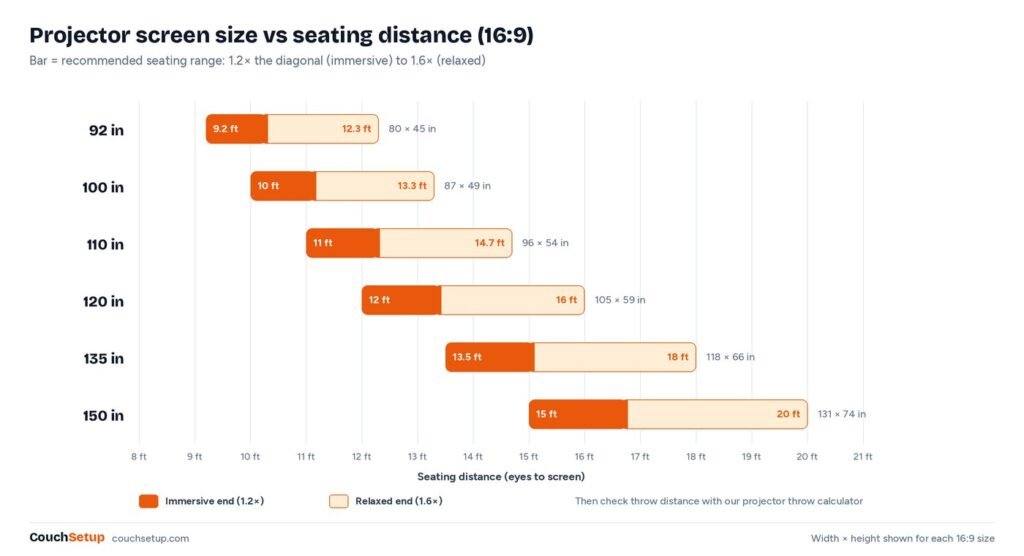
| 100 in | 87.2 × 49.0 in | about 10 to 13 ft |
| 110 in | 95.9 × 53.9 in | about 11 to 15 ft |
| 120 in | 104.6 × 58.8 in | about 12 to 16 ft |
| 135 in | 117.7 × 66.2 in | about 13.5 to 18 ft |
Stick with 16:9 unless you have a dedicated movie room and a projector with lens memory: a 120-inch 2.35:1 screen is only about 47 inches tall versus nearly 59 for 16:9. Planning the room? See small living room home theater.
Screen or white wall?
A smooth matte white wall is fine for testing a projector. A screen is perfectly smooth, color-neutral and framed in black, which boosts perceived contrast. Projector Central’s test found a properly prepped painted wall can look on par with a fabric screen, but prep is everything, and no paint replaces a CLR screen for a UST.
Acoustically transparent screens let speakers sit behind the picture. Sound & Vision says perforated screens start softening treble around 5 to 6 kHz and woven ones around 10 kHz, and perforated ones can show moiré, so woven is safer at home. Plan speakers with our speaker placement calculator.
Mistakes to avoid
- A CLR or UST screen with a ceiling-mounted projector.
- A roll-down screen with a UST or short-throw; steep light exaggerates every ripple.
- Going bigger than the projector can light (see the brightness table).
- Mounting too high; keep the image center near seated eye level.
- White walls beside the screen bouncing light back; darker paint nearby helps.
- Cleaning with solvents. Soft brush, or mild soapy water only if the maker allows.
Still deciding on a projector at all? Read projector vs TV.
How we picked
We gathered the measurements and expert reviews for every pick, put them side by side, and worked out the room numbers the individual reviews leave out. Gain, sizes and compatibility were checked on Silver Ticket’s, Elite’s and Akia’s own pages, reviews come from The Smart Home Hookup, Projector Reviews and High-Def Digest, and the brightness and size tables are our own sums. Every source is listed at the end.
FAQ
What’s the best projector screen for a living room?
With a ceiling or shelf projector, a standard-throw ALR like the CineGrey 5D. With a UST, a CLR screen or a floor-rising Vividstorm. In a dark room, a matte white Silver Ticket STR.
Is a screen better than a white wall?
Usually. It’s smoother, color-neutral and framed in black. A prepped painted wall can come close in a dark room.
Do I need an ALR screen?
Only if you watch with lights on or daylight. With a UST projector, a CLR screen is strongly recommended.
What gain should I get?
1.0 to 1.1 for most rooms. 1.2 to 1.5 for a dimmer projector or narrow seating.
What size should I get?
100 inches suits about 10 to 13 feet of seating, 120 inches about 12 to 16 feet, if your projector can light it.
Related guides
Sources: Silver Ticket STR-169120 specs · Elite Aeon CineGrey 5D specs · Elite Aeon CLR 3 specs · Akia Screens CLR materials · The Smart Home Hookup UST screen comparison · ProjectorScreen.com: foot-lamberts · Projector Central: painting a screen · Sound & Vision: acoustically transparent screens