

A small living room home theater can feel better than a big one. You sit closer, so a 55 or 65-inch TV feels huge. Sound fills the space easily, so you don’t need a big speaker system. The hard part is fitting it all in: the couch, the TV, the speakers and the walkway all fight for the same few feet.
Our verdict
Short answer: for most small living rooms, a 55 or 65-inch TV mounted at eye level, a compact soundbar centered under it, hidden cables and one really comfortable sofa. Add rear speakers only if the sofa floats away from the back wall.
Measure three things first
- Seating distance from your eyes on the couch to the TV wall. This sets the screen size; try our TV size calculator.
- TV wall width, so the TV and anything beside it fit.
- Walkway: keep 30 to 36 inches clear for walking paths. A setup that blocks the way to the kitchen won’t last.
What most room guides don’t tell you
Your room width is not your seating distance
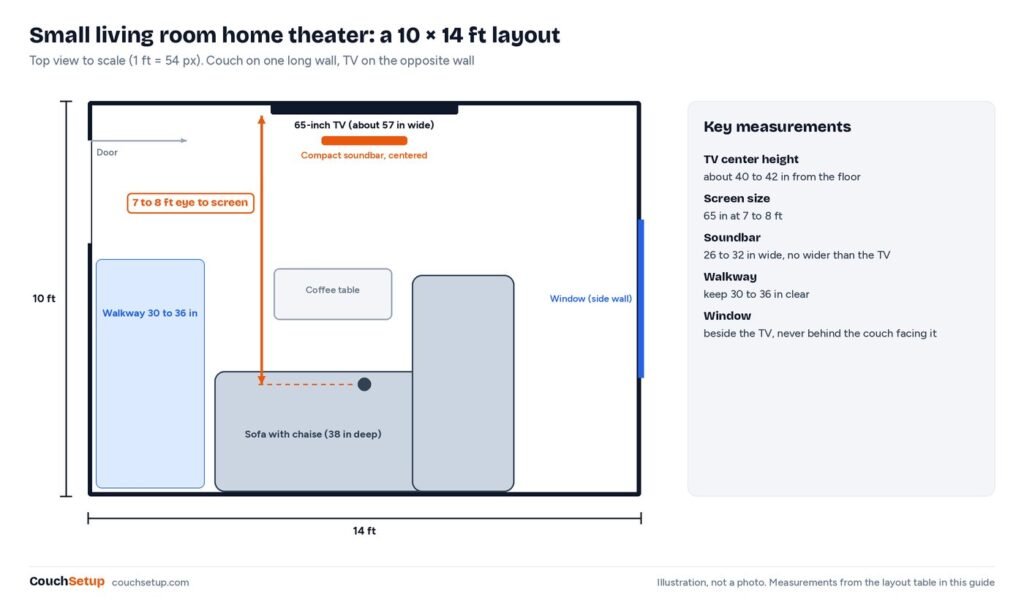
People size the TV to the room, but the sofa eats a lot of it. In a room 10 feet (120 inches) across, take off about 3 inches for a wall-mounted TV, about 4 inches with the sofa pulled off the back wall, and roughly 25 inches from the back wall to your eyes on a typical 38-inch-deep sofa. That leaves about 88 inches, or 7 feet 4 inches, which is the real number to size the screen from. On a console instead of a wall mount, subtract another foot or so.
The popular quick formula runs a little big
Kaleidescape’s handy rule is distance × 0.65 for a 30° view and × 0.835 for 40°. When we worked the angles out exactly for a 16:9 screen, the 40° figure matches, but the 30° one is closer to × 0.615. In a small room that’s a few inches of screen, so here are the exact numbers:
| Couch to screen | Everyday (30°) | Cinematic (40°) | Small-room sweet spot |
|---|---|---|---|
| 5 ft | about 37 in | about 50 in | 43 to 50 in |
| 6 ft | about 44 in | about 60 in | 50 to 55 in |
| 7 ft | about 52 in | about 70 in | 55 to 65 in |
| 8 ft | about 59 in | about 80 in | 65 to 75 in |
| 9 ft | about 66 in | about 90 in | 75 in, or a 100-in projector |
Kaleidescape also notes that around 7 feet from a 70-inch screen, 4K is worth having, so sitting close to a 4K TV is an advantage. Torn between sizes? See 65 vs 75-inch TV.
Layout 1: the long, narrow room (about 10 × 14 ft)
Common in apartments: the couch on one long wall, the TV opposite, about 7 to 8 feet away.
| Part | What fits | Why |
|---|---|---|
| Screen | 65-inch TV | At 7 to 8 ft, between comfortable and immersive |
| Sound | Compact soundbar, 26 to 32 in wide | No room for side speakers |
| Extras | Wall mount, cord cover, bias light | Frees floor space |
| Seating | Sofa with a chaise, not a full sectional | Lounging without blocking the walkway |
Good fits: a bright Mini LED from our best TVs for small rooms if it gets daylight, a Sonos Beam or Sony HT-S2000 from best soundbars for small rooms, and a cord cover.
Layout 2: the square room (about 12 × 12 ft)
More flexible, but doors and windows usually take a wall or two. Put the TV on the wall with the fewest windows, and not directly opposite one.
| Part | What fits | Why |
|---|---|---|
| Screen | 65-inch TV, or a short-throw projector at 100 in | 8 to 9 ft seating works for both |
| Sound | Soundbar with wireless sub and rears | Real surround without long wires |
| Extras | Blackout curtains for a projector | Projectors need a darker room |
| Seating | L-shaped sectional or sofa plus a chair | Everyone stays in the sweet spot |
Short-throw projectors need about 3.5 to 8 feet for 100 inches depending on the model; check yours in the projector throw calculator and see the best short-throw projectors.
Layout 3: studio or open-plan corner (about 9 × 10 ft)
| Part | What fits | Why |
|---|---|---|
| Screen | 48 to 55-inch TV | Seating is usually 5 to 7 ft away |
| Sound | Small soundbar with night mode, or TV headphones | Neighbors and roommates |
| Extras | Floor stand with a TV mount | Renter-friendly, no drilling |
| Seating | Loveseat or modular sofa | Easy to rearrange |
Renting? Our no-drilling TV setup covers stands and damage-free cable hiding.
Which layout fits your room
| If your room… | Start with | Watch out for |
|---|---|---|
| Has the couch on a long wall, TV opposite | Layout 1 | The walkway to the door |
| Is roughly square with windows on two walls | Layout 2 | A window facing the screen |
| Shares space with a bed, desk or kitchen | Layout 3 | Noise for others |
| Has a fireplace on the best wall | Layout 1 or 2, TV beside it | Mounting too high |
| Is dark most evenings and you want 100 in | Layout 2 with a projector | Daylight; plan curtains first |

If two fit, choose the one that keeps the walkway clear. Replacing the sofa? Compare compact recliners in our home theater seating guide or sofas in the best couches for movie nights.
Rear speakers: when to skip them
Rears are a real upgrade in a square room where the couch sits in the middle. But if the sofa touches the back wall, the room is a studio, or you share walls and watch late, a good soundbar alone is better. You can also start with a bar that supports rears later, like the Sonos Beam.
Cheap acoustic fixes
Hard walls close to your ears make reflections arrive fast and blur dialogue, and bass piles up in corners. Crutchfield’s acoustics guide notes carpet and drapes absorb a lot of sound above about 500 Hz, while glass and drywall reflect it.
- An area rug between the couch and TV on hard floors.
- Curtains over big windows, which also cut glare.
- A bookshelf with mixed-size books on a side wall to diffuse reflections.
- Pull the couch off the back wall as far as the walkway allows; Crutchfield says bass and reflections build up there.
- The mirror trick: sit on the couch while someone slides a mirror along the side wall. Wherever you can see the soundbar in it, a curtain or panel helps most.
Soundbar and subwoofer placement
Center the soundbar slightly in front of the TV so the screen doesn’t block it. If it has up-firing Atmos drivers, TechRadar says to keep the path to a flat ceiling clear. Connect over HDMI eARC, not optical, and run room calibration if it has one.
Start the sub beside the soundbar. If bass is boomy or thin at the couch, SVS’s subwoofer crawl helps: sub on your seat, steady bass playing, crawl around the possible spots and put the sub where it sounds smoothest. SVS explains a corner excites all of a room’s bass modes, so turn the level down if it ends up there. Our speaker placement calculator gives exact spots.
A one-weekend setup
- Measure and sketch: seating distance, wall width, doors, windows and outlets.
- Pick the screen size from the seat, using the table above.
- Mount or stand: aim for a screen center around 40 to 42 inches from the floor.
- Place the sofa, centered on the TV and a little off the back wall, with 30 to 36 inches to walk.
- Connect the soundbar to the TV’s HDMI eARC port and set the output.
- Use Filmmaker or Movie mode for films; see our picture settings guide.
- Hide the cables and add a TV backlight for night viewing.
| Budget | Screen | Sound | Extras |
|---|---|---|---|
| Starter | 50 to 55-inch Mini LED | Budget soundbar | Cord cover |
| Sweet spot | 55 to 65-inch Mini LED, or 48 to 55-inch OLED | Compact premium soundbar | Wall mount, backlight |
| Cinema | 65-inch OLED, or short-throw projector and screen | Soundbar with sub and rears | Blackout curtains, better seating |
Full gear lists in our home theater under $1,000 guide.
How we picked
We gathered the measurements and expert guidance for every recommendation, put them side by side, and worked out the room-fit numbers the individual guides leave out. The viewing-distance table and the room-width example are our own sums; the acoustic and subwoofer advice comes from Crutchfield, SVS, TechRadar and Kaleidescape. Every source is listed at the end.
FAQ
What size TV is best for a small living room?
From 6 to 8 feet, 55 to 65 inches. Measure from your eyes on the couch, not the wall behind it.
Can I put a projector in a small living room?
Yes, a short-throw makes 100 inches from about 3.5 to 8 feet depending on model. Plan curtains too.
Do I need surround speakers in a small room?
No. A good compact soundbar sounds great. Wireless rears are worth it only if the sofa floats.
How far should a couch be from a 55-inch TV?
About 7 ft 5 in for a 30° everyday view, or about 5 ft 6 in for a cinematic 40° view.
How do I reduce echo in a small TV room?
A rug, curtains and a bookshelf, then pull the couch a few inches off the back wall.
Related guides
- Home theater setup guide
- Best TVs for small rooms
- Best soundbars for small rooms
- Home theater under $1,000
Sources: Kaleidescape: screen size and viewing distance · Crutchfield: room acoustics · SVS: the art of subwoofer placement · TechRadar: Dolby Atmos soundbar tips · Dolby: speaker setup guides