
CouchSetup is reader-supported. When you buy through links on our site, we may earn an affiliate commission at no extra cost to you. Learn more
In a small room you don’t need a big soundbar with a subwoofer that rattles the walls. You need voices you can follow at low volume, a bar that fits under the TV or on the dresser, and a night mode so you don’t wake anyone. That’s a different shopping list from the usual “best soundbar” roundups, and it rules out a lot of popular bars.
Our verdict
Quick picks: the Sonos Beam (Gen 2) is the best soundbar for small rooms for most people. Get the Sony HT-S2000 if you want a real center channel and your TV is 50 inches or bigger, the Bose Smart Soundbar for bedrooms and late-night TV, the Sonos Ray if it has to fit inside a cabinet, and the Amazon Fire TV Soundbar on a tight budget.

Top picks at a glance
Best overall
Sonos Beam (Gen 2)
Small living rooms and anyone who may add speakers later
$$ Mid-rangeBest for movies
Sony HT-S2000
Movie fans with a 50-inch or bigger TV
$$ Mid-rangeBest for bedrooms
Bose Smart Soundbar
Bedrooms, apartments and hard-to-hear dialogue
$$ Mid-rangeThe five picks side by side
| Soundbar | Width | Depth | TV connection | Atmos | Fits TVs | Price |
|---|---|---|---|---|---|---|
| Sonos Ray | 22.0 in | 3.7 in | Optical only | No | 32 to 55 in | $$Check price |
| Amazon Fire TV Soundbar | about 24 in | about 3.5 in | HDMI ARC, optical | No | 32 to 55 in | $Check price |
| Sonos Beam (Gen 2) | 25.6 in | 3.9 in | HDMI eARC | Virtual | 43 to 65 in | $$Check price |
| Bose Smart Soundbar | 27.3 in | 4.1 in | HDMI eARC, optical | Up-firing | 43 to 65 in | $$Check price |
| Sony HT-S2000 | 31.5 in | 4.9 in | HDMI eARC, optical | Virtual, plus DTS:X | 50 to 75 in | $$Check price |
What the reviews don’t tell you
Most reviews judge a soundbar on its own. In a small room the bar has to fit a particular TV, shelf and ceiling, so we lined the specs up against each other. A few things came out of that.
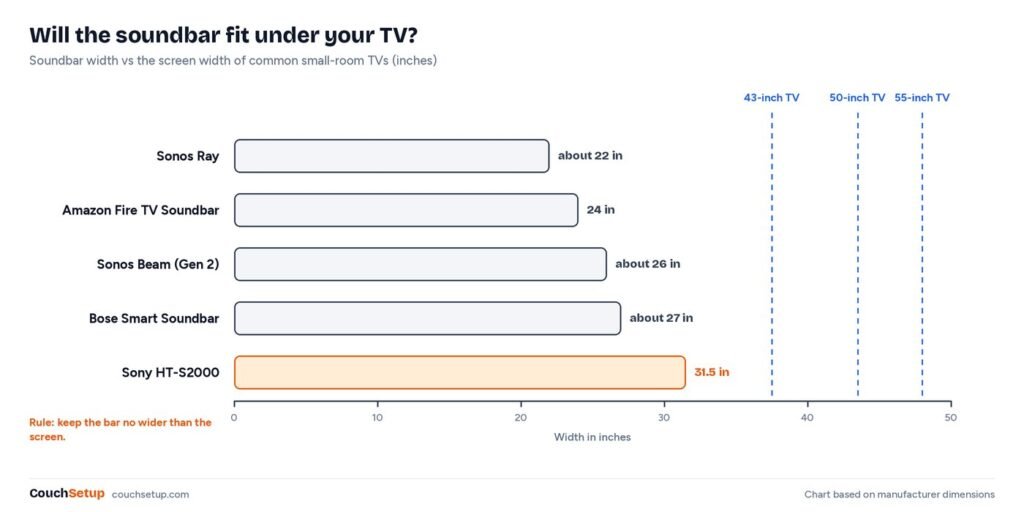
Wider than the TV is a real risk, even with “compact” bars
A 43-inch TV’s screen is only about 37.5 inches wide, a 50-inch about 43.5 and a 55-inch about 48. Every bar here fits under a 43-inch set, but a 32-inch TV is only about 27.9 inches across. The Sony is 31.5 inches, so it hangs past the edges of a 32-inch screen, and the Bose at 27.3 inches only just fits.
Footprint matters more than width on a shelf
If the bar sits on a narrow shelf or dresser, multiply width by depth. The Ray takes about 81 square inches and the Fire TV Soundbar about 84, both smaller than a sheet of letter paper (93.5). The Beam needs about 101 and the Bose about 112. The Sony needs about 154, nearly twice the Ray, because it’s almost 5 inches deep.
Optical costs you more than Atmos
The Ray only has an optical input. Most reviews mention that this rules out Dolby Atmos. Fewer point out the day-to-day catch: Sony’s own support pages say TV remote power and volume control doesn’t work over optical. You’ll be teaching the bar your TV remote or using a second one. On a TV with HDMI ARC, the Fire TV Soundbar or Beam avoids that.
Reviewers split on the Beam’s tuning and the Bose’s bass
RTINGS calls the Beam the best small soundbar it has tested, and Sound & Vision gave it a Top Pick. But Sound & Vision also says skipping Trueplay tuning costs it a lot, and on the Beam that tuning needs an iPhone or iPad. TechRadar liked the Bose’s up-firing Atmos but flagged light bass and a narrow soundstage. Android households, keep that first point in mind.
The picks
1. Sonos Beam (Gen 2): best overall
Sonos Beam (Gen 2)
Best for Small living rooms and anyone who may add speakers later
- About 26 inches wide
- Virtual Dolby Atmos over HDMI eARC
- Night Sound and Speech Enhancement
- Add a Sonos sub and rear speakers later
Prices change often, so check today’s price on Amazon.
The Beam has been the default compact recommendation for years, and it still is. For a 25.6-inch bar it sounds wide, voices come through clearly, and Night Sound and Speech Enhancement keep dialogue audible at low volume. It also plays music well over Wi-Fi and AirPlay 2.
The other reason to pick it is the upgrade path. Start with the bar, then add a Sonos sub and two rears later for a wireless surround system. Torn between this and the Bose? See Sonos Beam vs Bose Smart Soundbar.
The catch: no Bluetooth, no DTS:X, and the Atmos is virtual. Trueplay tuning needs an Apple device.
2. Sony HT-S2000: best for movies and dialogue
Sony HT-S2000
Best for Movie fans with a 50-inch or bigger TV
- True 3.1 channels with a center speaker
- Built-in dual subwoofers
- Dolby Atmos and DTS:X
- HDMI eARC, optical and Bluetooth
Prices change often, so check today’s price on Amazon.
The HT-S2000 has something most compact bars skip: a dedicated center channel, the speaker that carries voices. Secrets of Home Theater and High Fidelity praised its balanced dialogue and found more bass than expected from the built-in dual subwoofers, with no distortion at high volume. It decodes Dolby Atmos and DTS:X, which helps if you play Blu-rays.
The catch: at 31.5 inches wide and almost 5 inches deep it suits a 50-inch TV and up. There’s no Wi-Fi or AirPlay, the same review found acoustic music a bit reverberant, and you supply your own wall-mount screws.
3. Bose Smart Soundbar: best for bedrooms
Bose Smart Soundbar
Best for Bedrooms, apartments and hard-to-hear dialogue
- About 27 inches wide
- Up-firing drivers for Dolby Atmos
- AI Dialogue Mode for clear voices
- Wi-Fi, AirPlay, Chromecast and Bluetooth
Prices change often, so check today’s price on Amazon.
If you mostly watch at night, or someone in the house struggles to follow speech, the Bose is a strong fit. AI Dialogue Mode lifts voices automatically, and at 2.2 inches tall it’s the least likely bar here to block a low screen. It’s also the only pick with real up-firing drivers, which TechRadar found more convincing than virtual Atmos. You can even pair Bose Ultra Open Earbuds as personal rear speakers.
The catch: bass is light without the Bose sub, and TechRadar noticed Dialogue Mode sometimes lifts sounds that aren’t voices. The earbuds cost extra and only help one listener.
4. Sonos Ray: best tiny soundbar
Sonos Ray
Best for Very small rooms, dorms and desks
- About 22 inches wide
- Forward-facing design fits inside TV cabinets
- Night Sound and Speech Enhancement
- Great music playback over Wi-Fi
Prices change often, so check today’s price on Amazon.
The Ray is Sonos’ smallest bar. All its sound fires forward, so it works inside a TV cabinet or on a shelf where other bars would get muffled. What Hi-Fi rates its vocal clarity as excellent, crisp without turning harsh.
The catch: it’s optical only, so no Atmos and no TV remote control over HDMI. What Hi-Fi also notes a limited low end and narrow soundfield. For a dorm or small bedroom that’s an easy trade.
5. Amazon Fire TV Soundbar: best budget pick
Amazon Fire TV Soundbar
Best for Anyone upgrading from TV speakers on a small budget
- 24 inches wide
- DTS Virtual:X for wider sound
- HDMI ARC, optical and Bluetooth
- Very easy setup
Prices change often, so check today’s price on Amazon.
If you just want to hear the TV better without spending much, this 24-inch bar does the job. It has HDMI ARC so the TV remote controls it, Bluetooth for music, and DTS Virtual:X to widen the sound. It often drops further during Prime Day and Black Friday.
The catch: no center channel, no Wi-Fi, no Atmos, and it can’t add a sub. TechRadar found male voices could get boomy with bass on medium and the sound got harsh when pushed loud. It’s a step up from TV speakers, not a home theater.
Which pick for which room
| Room or situation | Pick | Why |
|---|---|---|
| Small living room, may add speakers later | Sonos Beam (Gen 2) | Wide sound for its size and a clear upgrade path |
| 50-inch or bigger TV, mostly movies | Sony HT-S2000 | Real center channel, Atmos and DTS:X |
| Bedroom dresser, late-night TV | Bose Smart Soundbar | Dialogue mode and a slim, low body |
| Dorm, desk or inside a TV cabinet | Sonos Ray | Fires forward, so it works on a shelf |
| Tight budget, first upgrade | Amazon Fire TV Soundbar | Simple HDMI ARC setup and Bluetooth |
| Older TV with no HDMI ARC | Sonos Ray | Optical is all it needs |
Shared walls are their own problem. Bass travels through floors and walls whichever bar you pick, so for late nights in an apartment, pair it with wireless TV headphones rather than relying on night mode alone.
Using one with a Sony TV
All five work with a Sony BRAVIA from the last few years. Plug the bar into the TV’s HDMI port marked ARC or eARC (on the 2022 X85K, for example, that’s HDMI 3), set BRAVIA Sync control to On, then pick the soundbar as the audio output. BRAVIA Sync is just Sony’s name for HDMI-CEC, which Sonos, Bose and Amazon bars all support. If the bar doesn’t show up, Sony suggests trying a known-good HDMI cable and skipping adapters.
The HT-S2000 is the obvious same-brand match, but on a 43-inch Sony the Beam is the better fit. Not sure which port is which? Our HDMI ARC vs eARC guide explains the difference.
How to choose
Measure the screen, not the TV size
A bar looks and sounds most natural when it’s no wider than the screen. Measure the glass edge to edge, then check the width column above. Consumer Reports gives the same rule for smaller TVs.
Use HDMI eARC if you can
One cable carries the sound, the TV remote controls the volume, and you get Atmos where the bar supports it. Optical works, but you lose formats and remote control.
Night mode and dialogue mode beat raw power
In apartments and bedrooms these matter more than wattage. Night modes squash loud explosions so quiet voices stay audible.
You probably don’t need a subwoofer
Small rooms boost bass on their own, and a separate sub can be too much through shared walls. Start without one. Every pick except the Fire TV Soundbar can add one later. If you do want a sub in the box, see the best soundbars under $300.
Check your ceiling before paying for up-firing Atmos
Dolby’s installation guidelines say up-firing speakers like the Bose’s work with flat, reflective ceilings between 7.5 and 14 feet, ideally 7.5 to 12. Most US bedrooms fit. With a vaulted or angled ceiling, Dolby advises against relying on them, so the Beam or a dialogue-focused bar is the better buy.
Who should skip a compact bar
If the room is large or open-plan, or you want bass you can feel, a bar with a separate sub will do more. If you want sound from behind the couch, read soundbar vs surround sound first.
Placement and tuning
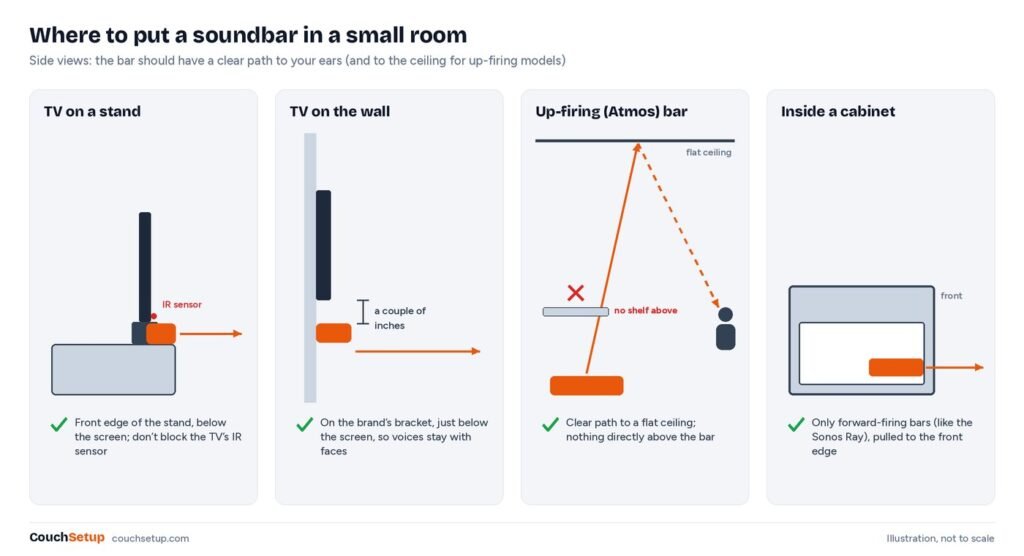
In a small room you sit close to the bar and close to the walls, so a few inches change what you hear. Polk Audio’s advice for virtual Atmos bars applies to all of them: below and in front of the TV, with nothing in the way.
| Situation | Where to put it |
|---|---|
| TV on a stand | Front edge of the stand, centered under the screen |
| TV on the wall | A couple of inches below the screen, on the brand’s bracket |
| Bedroom dresser | Front edge, aimed at the bed |
| Inside a cabinet | Only forward-firing bars like the Ray, pulled to the front |
| Up-firing bar | Nothing above it, so the drivers have a clear path to the ceiling |
If bass sounds boomy, pull the bar and any sub away from corners. Polk explains that walls and corners act like an amplifier for bass. Turn the bass setting down before blaming the bar, since most compact bars ship tuned for bigger rooms. If voices echo, a rug, curtains or a bookshelf will soak up reflections.
Sonos’ Trueplay measures your room and tunes the Beam and Ray around it. On these two it uses Advanced Tuning, which takes about three minutes walking the room with an iPhone or iPad. Re-run it any time you move the bar or the couch. On other bars, start in standard or movie mode with bass and treble flat, then change one notch at a time.
Still losing voices? Our guide to fixing dialogue you can’t hear goes through TV and soundbar settings step by step.
How we picked
We gathered the measurements and expert reviews for every pick, put them side by side, and worked out the room-fit numbers the individual reviews leave out. We looked at compact bars up to about 32 inches wide and judged each on dialogue clarity, bass without a sub, night features, connections and how easy it is to live with. Every source is listed at the end.
FAQ
What size soundbar do I need for a small room?
One no wider than your screen. For 43 to 55-inch TVs, 22 to 27 inches is the sweet spot.
Is Dolby Atmos worth it in a small room?
It’s a nice extra, not a must. Real up-firing drivers like the Bose’s do it better than virtual Atmos, but clear dialogue matters more for everyday TV.
Can I use a soundbar without HDMI?
Yes. Most bars have an optical input and the Sonos Ray is optical only. You lose Atmos, and the TV remote won’t control volume over optical.
Should the soundbar go above or below the TV?
Below if you can, near the front edge of the stand. Above works when there’s no other option, but voices will seem to come from over the picture.
Does a soundbar work inside a TV cabinet?
Only forward-firing bars like the Sonos Ray, pulled to the front edge. Side and up-firing drivers lose most of their effect in there.
Do I need an iPhone to tune a Sonos Beam?
For Trueplay on the Beam (Gen 2) and Ray, yes. Quick Tuning works with Android but only on newer Sonos models.
Are these sold in the UK?
Yes. All five are, and Amazon brought the Fire TV Soundbar to the UK in July 2024. The size and connection advice is the same.
Related guides
- Small living room home theater setups
- Best TVs for small rooms
- Soundbar vs surround sound
- Home theater setup guide
Sources: RTINGS best small soundbars · What Hi-Fi best soundbars · HomeTheaterHifi Sony HT-S2000 review · TechRadar Bose Smart Soundbar review · TechRadar Fire TV Soundbar review · Sonos Beam (Gen 2) specs · Sony HT-S2000 specifications · Sound & Vision Sonos Ray specs · Sony: connect a sound bar with BRAVIA Sync · Sonos: Trueplay · Polk Audio: subwoofer placement · Consumer Reports soundbar buying guide · Dolby Atmos installation guidelines (PDF)