
CouchSetup is reader-supported. When you buy through links on our site, we may earn an affiliate commission at no extra cost to you. Learn more
The best TV for bright room viewing has to do two things at once. It needs enough brightness to compete with the sun, and a screen that doesn’t turn the window behind you into a mirror. Plenty of TVs manage one of those. The six below manage both, from a budget Mini-LED to a flagship that measured close to 4,000 nits.
Our verdict
Quick picks: the Sony BRAVIA 9 II if budget isn’t the limit. The Samsung S95H if you want an OLED in a sunny room. The TCL QM7L for the most brightness per dollar, the Hisense U7SG for daytime sports and 100-inch screens, and the Hisense U6SF Pro on a tight budget.
Top picks at a glance
Best overall
Sony BRAVIA 9 II
Sunny living rooms where budget is not the main limit
$$$ PremiumBest OLED for bright rooms
Samsung S95H OLED
Movie lovers with a sunny room who still want OLED blacks
$$$ PremiumBest-value matte OLED
Samsung S90H OLED
Smaller rooms, bedrooms and gamers who want a glare-free OLED for less
$$ Mid-rangeThe six picks side by side
| TV | Best for | Type | HDR peak (10% window) | Screen finish | Price |
|---|---|---|---|---|---|
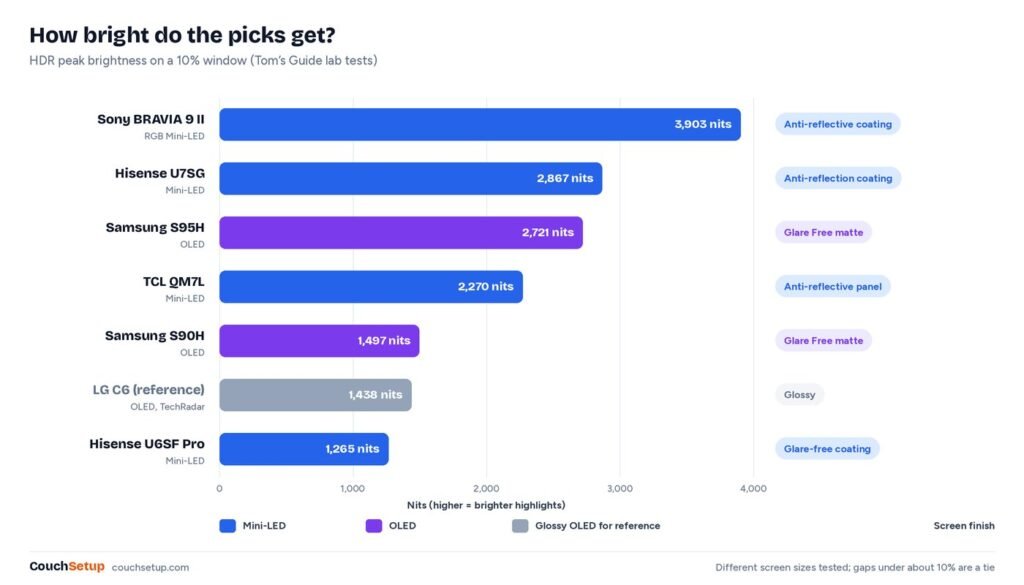
| Sony BRAVIA 9 II | Best overall | RGB Mini-LED | 3,903 nits | Anti-reflective coating | $$$Check price |
| Samsung S95H | Best OLED | OLED | 2,721 nits | Glare Free matte | $$$Check price |
| Samsung S90H | Cheapest matte OLED | OLED | 1,497 nits | Glare Free matte | $$Check price |
| TCL QM7L | Best value | Mini-LED | 2,270 nits | Anti-reflective panel | $$Check price |
| Hisense U7SG | Sports, big screens | Mini-LED | About 2,867 nits | Dual-layer anti-reflection | $$Check price |
| Hisense U6SF Pro | Best budget | Mini-LED | 1,265 nits | Anti-glare coating | $Check price |
What the reviews don’t tell you
Each review looks at one TV. When we put the numbers for all six next to each other, a few things showed up that you won’t see in any single review.
The brightest TV on paper is the dimmest out of the box
Here’s the odd one. In HDR, the Sony is the brightest TV here by a long way. But most daytime TV, like news, sports and a lot of streaming, is SDR, not HDR. And in SDR, using the accurate picture mode Tom’s Guide measured, the Sony came out the dimmest of the six at 101 nits. The cheapest TV here, the Hisense U6SF Pro, was the brightest at 358 nits.
| TV | SDR, accurate mode | HDR peak | Price |
|---|---|---|---|
| Hisense U6SF Pro | 358 nits | 1,265 nits | $Check price |
| Samsung S95H | 253 nits | 2,721 nits | $$$Check price |
| Samsung S90H | 226 nits | 1,497 nits | $$Check price |
| TCL QM7L | 196 nits | 2,270 nits | $$Check price |
| Hisense U7SG | 185 nits | About 2,867 nits | $$Check price |
| Sony BRAVIA 9 II | 101 nits | 3,903 nits | $$$Check price |
That doesn’t mean the Sony is dim. It means its accurate SDR mode is tuned for a dark room, and you’ll want to switch to a brighter preset during the day. Every one of these TVs gets a lot brighter in SDR once you do that. The real lesson: if you watch mostly daytime TV and never touch the settings, the HDR number on the box tells you less than you’d think.
Glare handling matters more than the last 1,000 nits
The two Samsung OLEDs sit in the middle of the brightness list, yet reviewers rate their matte screens among the best at dealing with windows. A reflection of a bright window can be brighter than anything the TV shows, so a screen that scatters it into a soft haze often beats a brighter screen that mirrors it. If your TV faces a window, put screen finish ahead of peak brightness.
If you need a small bright-room TV, the choice is tiny
Only one TV here comes in 42 and 48 inches with a matte anti-glare screen: the Samsung S90H. Everything else starts at 55 inches. For a sunny bedroom or office, that narrows things down fast.
Where you sit matters as much as the window
The four Mini-LED TVs use LCD panels that lose some contrast and color when you watch from far off to the side, the Sony less than the others thanks to its wide-angle tech. In an open-plan room where someone watches from the kitchen, the two OLEDs will look best from those seats.
The picks
1. Sony BRAVIA 9 II: best overall
Sony BRAVIA 9 II
Best for Sunny living rooms where budget is not the main limit
- RGB Mini-LED backlight (Sony True RGB)
- 3,903 nits HDR peak in Tom’s Guide’s test
- Upgraded anti-reflective screen coating
- Wider viewing angle than the original BRAVIA 9
- 65, 75 and 85 inches
Prices change often, so check today’s price on Amazon.
Sony’s 2026 flagship is the brightest TV in this guide by a wide margin, at 3,903 nits in HDR. RTINGS also names it the best TV it has tested for a bright room. Tom’s Guide found the anti-reflective coating good enough to rival Samsung’s matte screens, and blooming was close to non-existent, so it still looks great at night.
The catch: it’s the most expensive pick, only two of its four HDMI ports are HDMI 2.1, it tops out at 120Hz, and it’s heavy at 58.6 pounds, so check your wall mount.
2. Samsung S95H: best OLED for a sunny room
Samsung S95H OLED
Best for Movie lovers with a sunny room who still want OLED blacks
- Glare Free matte OLED screen
- 2,721 nits HDR peak in Tom’s Guide’s test
- Four HDMI 2.1 ports, up to 165Hz
- 9.7 ms input lag
- 55, 65, 77 and 83 inches
Prices change often, so check today’s price on Amazon.
OLED used to be the wrong answer for a room full of daylight. The S95H’s Glare Free matte screen changes that: a window shows up as a soft haze instead of a sharp reflection. Tom’s Guide called it the brightest OLED it has tested. You also keep what makes OLED great, with no blooming and wide viewing angles, plus four HDMI 2.1 ports for gaming.
The catch: it’s expensive, it doesn’t support Dolby Vision, and like every matte screen, blacks look slightly gray when the room lights are on.
3. Samsung S90H: the cheaper matte OLED
Samsung S90H OLED
Best for Smaller rooms, bedrooms and gamers who want a glare-free OLED for less
- Glare Free anti-glare screen, new for this series
- 1,497 nits HDR peak in Tom’s Guide’s test
- Four HDMI 2.1 ports, up to 165Hz
- 9.3 ms input lag
- 42 to 83 inches
Prices change often, so check today’s price on Amazon.
For 2026 Samsung brought the same Glare Free finish down to the S90H, so you don’t need a flagship budget for a matte OLED. It’s about half as bright as the S95H in HDR, but Tom’s Guide said the anti-glare screen makes a world of difference in rooms with light you can’t control. It’s also the only matte option in 42 and 48 inches.
The catch: it’s noticeably dimmer than the Mini-LEDs on big bright scenes, and blacks are slightly raised.
4. TCL QM7L: most brightness for the money
TCL QM7L SQD Mini-LED
Best for Bright living rooms and big screens on a mid-range budget
- 2,270 nits HDR peak in Tom’s Guide’s test
- Up to 2,100+ local dimming zones
- High-contrast, anti-reflective HVA panel
- 4K 144Hz on two HDMI 2.1 ports
- 55 to 98 inches
Prices change often, so check today’s price on Amazon.
The QM7L gives you flagship-level brightness at a mid-range price, especially at 75 inches and up. Tom’s Guide measured 2,270 nits in HDR, and TCL lists up to 2,100+ dimming zones behind an anti-reflective panel. Blooming was minor in testing. Our full TCL QM7L review covers color, gaming and sound.
The catch: contrast and color fade for seats far off to the side, so it’s not ideal for a wide sectional.
5. Hisense U7SG: best for daytime sports
Hisense U7SG Mini-LED
Best for Daytime sports, gaming and 85 to 100-inch screens
- About 2,867 nits HDR peak in Tom’s Guide’s test
- Dual-layer Anti-Reflection and Glare-Free coating
- 165Hz native refresh rate
- 9.8 ms input lag
- 55 to 100 inches
Prices change often, so check today’s price on Amazon.
If the TV mostly shows Sunday afternoon football, this is the one. It’s the second-brightest set here, and Tom’s Guide said even the accurate Filmmaker mode looked fine in a bright room. The 165Hz panel keeps fast action smooth, and sizes go all the way to 100 inches. Weighing a bigger screen? Our 65 vs 75-inch comparison helps.
The catch: black levels are weak, so dark movie scenes look grayish. It’s a better daytime TV than a movie-night TV.
6. Hisense U6SF Pro: best on a budget
Hisense U6SF Pro Mini-LED
Best for Bright rooms on a tight budget, bedrooms and first apartments
- 1,265 nits HDR peak in Tom’s Guide’s test
- Anti-reflection, glare-free screen coating
- Native 144Hz panel
- Fire TV with Alexa+ built in
- 55 to 100 inches
Prices change often, so check today’s price on Amazon.
The Pro version of Hisense’s U6 adds the anti-glare screen that budget TVs usually skip. Tom’s Guide never had to adjust the lights to see it properly, and as the table above shows, it was the brightest of the six in accurate SDR. Our Hisense U6 review explains how it differs from the cheaper standard model.
The catch: some blooming around bright text on dark backgrounds, an ad-heavy Fire TV home screen, and only two HDMI 2.1 ports.
Matte screen or anti-reflective coating?
TV makers fight reflections in two ways. A matte screen has a finely textured surface that scatters light, so a window becomes a blurry haze. An anti-reflective coating keeps the screen glossy but uses thin layers that cut how much light bounces back, so reflections look fainter but stay sharp.
- Pick matte (Samsung S95H or S90H) if the TV faces a window or you watch with the curtains open most of the day.
- Pick a coated glossy screen (Sony, TCL, Hisense) if the room is only bright in the afternoon and you watch movies at night. Blacks stay a little deeper after dark.
A plain glossy OLED is the weakest choice for a sunny room. TechRadar saw strong mirror-like reflections on the LG C6 in dark scenes with the room lit, which is why it isn’t here despite being an excellent TV.
Where to put the TV in a bright room
Placement fixes more glare than any screen coating. Light bounces off a screen at the same angle it hits it, so the goal is to keep windows out of the line between the screen and your seat.
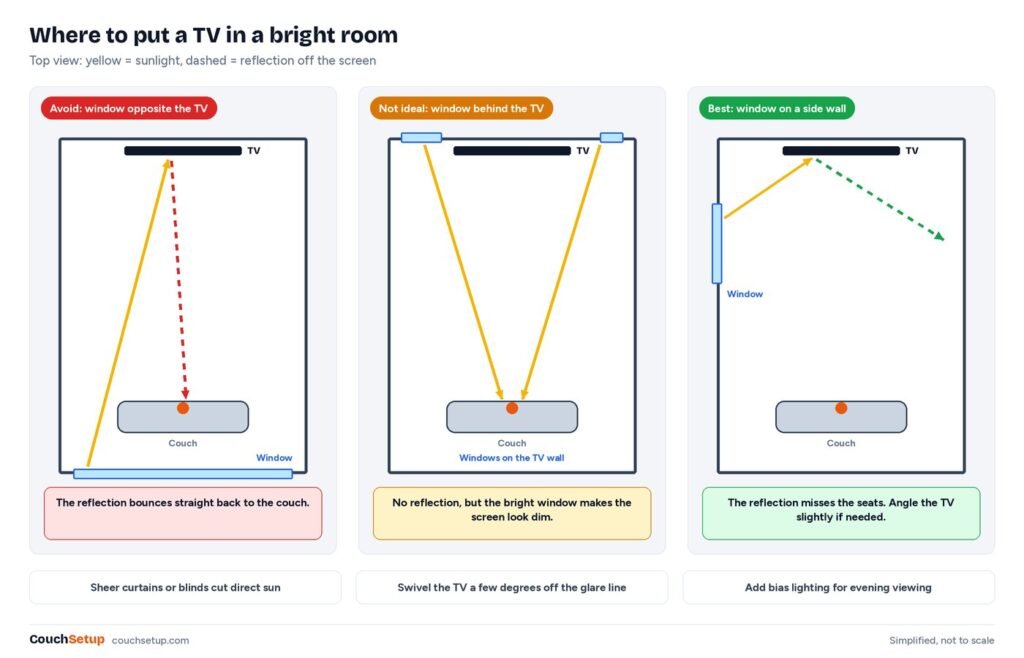
- Put the windows on a side wall if you can, so reflected light misses the seats.
- Don’t face the screen at a window. Every bright cloud ends up in the picture.
- Avoid a window right behind the TV. It doesn’t reflect, but your eyes adjust to the bright window and the screen looks washed out.
- Angle the TV a few degrees with a swivel mount to move a reflection off your seat. Check how high to mount a TV before you drill.
- Use sheer curtains or top-down blinds to cut direct sun without making the room dark.
Daytime picture settings
- Use a brighter preset during the day. Filmmaker and Movie modes are accurate but often dim, as the SDR numbers above show.
- Turn on the light sensor so the TV gets brighter as the room does.
- Raise backlight or brightness, not contrast or sharpness.
- On Mini-LED TVs, keep local dimming on Medium or High.
- Switch back to an accurate mode for movies at night.
For menus by brand, see our TV picture settings guide.
How we picked
We gathered the measurements and expert reviews for every pick, put them side by side, and worked out the room-fit numbers the individual reviews leave out. We started with 2026 TVs sold in the US and compared brightness, glare and viewing angles. Every source is listed at the end.
FAQ
What type of TV is best for a bright room?
Usually a Mini-LED TV with an anti-reflective coating, because it gets the brightest across the whole screen for the money. A matte OLED like the Samsung S95H is the best alternative if you want perfect blacks and wide viewing angles.
How many nits do you need for a bright room?
Aim for around 1,000 nits or more of HDR brightness plus a screen that controls reflections. Every TV in this guide measured over 1,200 nits in HDR.
Is OLED good in a bright room?
A matte OLED is. Samsung’s Glare Free S95H and S90H turn window reflections into a soft haze. A glossy OLED like the LG C6 shows sharp reflections in a lit room, so save it for rooms you can darken.
Why does my TV look dim during the day?
Most daytime TV is SDR, and accurate modes keep SDR dim. Switch to a brighter preset, raise the backlight and turn on the light sensor.
What is the brightest TV in 2026?
Of the TVs here, the Sony BRAVIA 9 II, at 3,903 nits in Tom’s Guide’s HDR test, followed by the Hisense U7SG at about 2,867 nits.
What size TV should I get for a bright room?
Room light doesn’t change the right size. Measure from your eyes to the screen and use our TV size calculator.
Related guides
Sources checked for specs, prices and measurements: RTINGS best TVs for bright rooms · Tom’s Guide Sony BRAVIA 9 II review · Tom’s Guide Samsung S95H review · Tom’s Guide Samsung S90H review · Tom’s Guide Hisense U6SF Pro review (incl. TCL QM7L SDR/HDR) · Tom’s Guide Hisense U7SG review · TechRadar LG C6 review · TechRadar Glare-Free vs anti-reflection OLED comparison