
CouchSetup is reader-supported. When you buy through links on our site, we may earn an affiliate commission at no extra cost to you. Learn more
OLED vs Mini LED is the big choice when you buy a premium TV, and the honest answer depends more on your room than on the spec sheet. OLED gives you perfect blacks, wide viewing angles and the cleanest motion. Mini LED gives you far more brightness, bigger screens for the money and no burn-in worry.
Our verdict
Short answer: it comes down to room light. Choose OLED if you mostly watch in the evening or can darken the room, love movies and dark games, or have wide seating. Choose Mini LED if the TV faces windows, you watch lots of daytime sports, want 75 inches or more on a budget, or leave static images up for hours. For mixed rooms the LG C6 is the best all-rounder; for sunny ones, the TCL QM7L.
Top picks at a glance
Best OLED overall
LG C6 OLED
Movie nights, gaming and mixed-light living rooms
$$$ PremiumBest value OLED
LG B6 OLED
Bedrooms, dark rooms and OLED on a tighter budget
$$ Mid-rangeBest Mini LED value
TCL QM7L SQD Mini LED
Bright living rooms and big screens on a budget
$$ Mid-rangeAt a glance
| Feature | OLED | Mini LED | Better |
|---|---|---|---|
| How it makes light | Each pixel lights itself | Thousands of small LEDs behind an LCD | Different design |
| Blacks and blooming | Perfect, no halos | Very good, some halos | OLED |
| Peak HDR (small highlights) | About 700 to 2,100+ nits | About 2,100 to 2,900 nits | Mini LED |
| Full-screen brightness | About 245 to 390 nits | Much higher | Mini LED |
| Viewing angles | Excellent | Fades off-center | OLED |
| Motion | Near-instant | Slower, slight trails | OLED |
| Input lag (game mode) | About 9 ms | About 9 to 10 ms | Tie |
| Burn-in | Possible | None | Mini LED |
| Largest sizes | Up to 83 in | 98 to 100 in | Mini LED |
What the reviews don’t tell you
Individual reviews quote one model’s numbers. Putting the measured results from TechRadar and Tom’s Guide side by side shows a pattern none of them spells out.
OLEDs keep less than a fifth of their peak brightness full-screen
| TV (type) | Peak, 10% window | Full-screen | Full-screen as % of peak |
|---|---|---|---|
| LG C6, 65 in (WOLED) | 1,438 nits | 245 nits | about 17% |
| Samsung S95F, 55 in (QD-OLED) | 2,132 nits | 390 nits | about 18% |
| Hisense UR8, 65 in (RGB Mini LED) | 2,097 nits | about 770 nits | about 37% |
The S95F and UR8 hit almost the same peak. But on a bright, full-screen scene like a snowy field or a daytime hockey game, the Mini LED holds about twice the share of its peak, and puts out roughly three times the light of the C6. That’s the gap you notice at noon, and it’s why peak brightness alone is a poor way to compare the two.
The cheap OLED is a different TV
Tom’s Guide measured the LG B6 at 695 nits, a little under half the C6. In a dark bedroom that hardly matters. In a sunny living room it does. So compare models, not just OLED against Mini LED.
Burn-in coverage isn’t a given
BGR found LG’s US OLED TV warranty doesn’t explicitly mention burn-in, relying on vague normal-use language, while LG’s OLED gaming monitors cover it in writing for two years. If a news ticker or one game will be on screen for hours every day, buy Mini LED or get burn-in coverage in writing.
How each one works
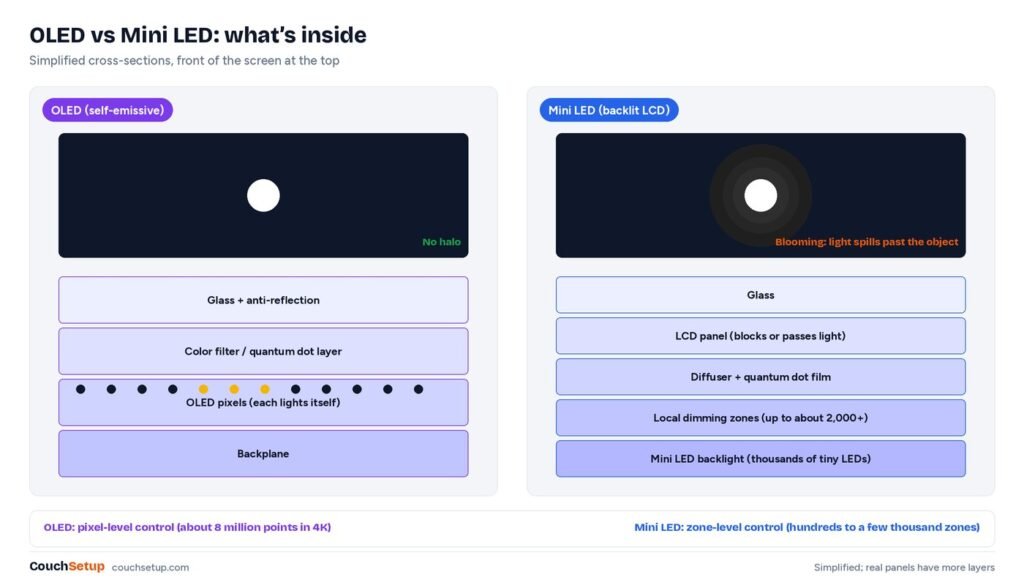
An OLED TV has no backlight. Each of its roughly 8 million pixels glows on its own and switches fully off for black. There are three main panel types in US stores: WOLED (LG Display, used in LG’s B and C series), QD-OLED (Samsung Display, used in the S95F and some Sonys, with punchier color at high brightness), and Tandem OLED, which stacks layers to get brighter. TechRadar reports the 42 to 65-inch LG C6 uses the same kind of panel as last year’s C5, while the 77 and 83-inch version, sold as the C6H, gets the brighter Primary RGB Tandem panel from the G6.
A Mini LED TV is an LCD with a much smarter backlight: thousands of tiny LEDs grouped into dimming zones. It dims zones behind dark areas and drives zones behind highlights hard. Even 2,000 zones are far coarser than 8 million pixels, though, so light can spill around bright objects. TCL lists up to 2,100+ zones for the QM7L. The newest version, RGB Mini LED, uses separate red, green and blue LEDs in each zone.
Blacks and blooming
This is OLED’s home turf. Dark scenes, letterbox bars and starfields stay inky, and white subtitles on black look clean. Good Mini LEDs have closed a lot of the gap: Tom’s Guide only spotted blooming on the QM7L in a brief fireworks scene, mostly from a corner. Cheaper sets show more, and Tom’s Guide criticized the Hisense U7SG’s blacks. Even TechRadar’s RGB Mini LED review found OLED blacks deeper. Winner: OLED.
Bright rooms and reflections
In a dim room, OLED’s contrast makes everything look deeper and you don’t need huge brightness. With big windows, Mini LED keeps the picture from washing out. Reflections matter too: TechRadar found the C6’s glossy screen quite reflective, while the S95F’s matte anti-glare screen killed mirror-like reflections at the cost of slight black crush. QD-OLED panels skip a polarizer, so their blacks can look a bit gray in a lit room. For window-facing walls, see our best TVs for bright rooms. Winner: Mini LED for bright rooms, OLED for dark ones.
Viewing angles
OLED looks almost the same from the end of the sofa. Most Mini LEDs use VA-type panels (the QM7L uses TCL’s HVA), which lose contrast and color off-center, and blooming is easier to see from an angle. With an L-shaped sectional, this matters more than peak brightness. Winner: OLED.
Gaming and motion
| Model | Type | Input lag | Max refresh | Price |
|---|---|---|---|---|
| LG C6 | OLED | 9.2 ms at 4K 60Hz (TechRadar) | 165Hz | $$$Check price |
| LG B6 | OLED | 8.9 ms (Tom’s Guide) | 120Hz | $$Check price |
| TCL QM7L | Mini LED | 9.4 ms (Tom’s Guide) | 144Hz on 2 ports | $$Check price |
| Hisense U7SG | Mini LED | 9.8 ms (Tom’s Guide) | 165Hz | $$Check price |
Lag is a tie. The real difference is motion: OLED pixels change almost instantly, so fast pans stay crisp, while LCD pixels can leave faint trails. The flip side is burn-in from static HUDs if you play one game for hours every day. For console picks, see best TVs for PS5 and Xbox. Winner: OLED for motion, Mini LED for marathon sessions of one game.
Burn-in and lifespan
If the same bright, static image stays up for many hours a day, OLED can keep a permanent ghost. Pixel shift, logo dimming and panel refresh cycles cut the risk for normal mixed viewing. RTINGS ran the toughest public test, 100 TVs showing CNN at max brightness for 28 months. As Guru3D reported, the OLEDs did burn in, but many LCDs also degraded or failed, with edge-lit models hit hardest. Neither is risk-free; your habits decide which risk matters. Winner: Mini LED for peace of mind.
Size and price per inch
Mini LED is the value pick, and the gap widens with size. The QM7L runs 55 to 98 inches and the U7SG 55 to 100, while LG’s C6 and B6 stop at 83. At 65 inches and up, a mid-range Mini LED usually costs well below a comparable OLED. Going small is the opposite: OLED’s 42 and 48-inch sizes are rare in premium Mini LED. Our 65 vs 75-inch comparison shows how a bigger Mini LED can beat a smaller OLED for the same money.
Which one for your room
| Your room and habits | Pick | Why |
|---|---|---|
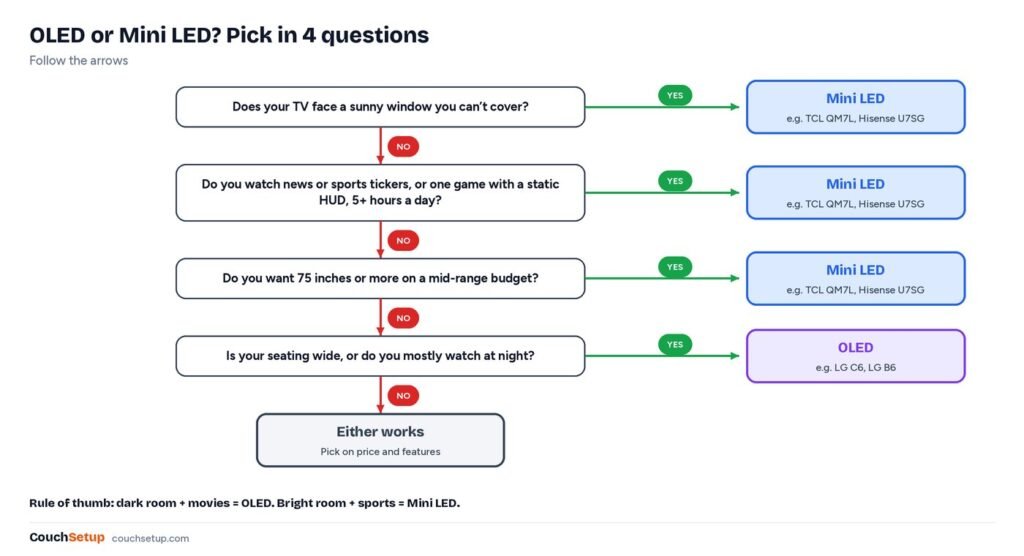
| Dark home theater or basement | OLED | Perfect blacks, no blooming |
| Bedroom, small screen | OLED (B6 or C6) | Small sizes, deep blacks at night |
| Sunny living room | Mini LED | Much more full-screen brightness |
| Mixed-light family room | Either | C6 for movie nights, QM7L if daytime TV dominates |
| 75 in+ for sports | Mini LED | Big for less, no burn-in from score bugs |
| Competitive gaming | OLED | Fastest pixel response |
Four TVs for each path
LG C6: best OLED for most people
LG C6 OLED
Best for Movie nights, gaming and mixed-light living rooms
- WOLED panel in 42 to 65-inch sizes
- 1,438 nits HDR peak in TechRadar’s test
- Four HDMI 2.1 ports, up to 4K 165Hz
- 9.2 ms input lag at 4K 60Hz
- Glossy screen can reflect windows
Prices change often, so check today’s price on Amazon.
Perfect blacks, top gaming features and accurate color out of the box. The catch: a reflective screen and only 245 nits full-screen. Full details in our LG C6 review.
LG B6: the value OLED
LG B6 OLED
Best for Bedrooms, dark rooms and OLED on a tighter budget
- Same perfect blacks and wide viewing angles
- 695 nits HDR peak in Tom’s Guide’s test
- Four HDMI 2.1 ports, 4K 120Hz
- Sizes from 48 to 83 inches
Prices change often, so check today’s price on Amazon.
OLED contrast for less. The catch: under half the C6’s peak brightness, so keep it out of sunny rooms.
TCL QM7L: best Mini LED for bright rooms
TCL QM7L SQD Mini LED
Best for Bright living rooms and big screens on a budget
- 2,270 nits HDR peak in Tom’s Guide’s test
- Up to 2,100+ local dimming zones
- Anti-reflective HVA panel
- 4K 144Hz on two HDMI 2.1 ports
- Sizes from 55 to 98 inches
Prices change often, so check today’s price on Amazon.
Tom’s Guide found it bright, colorful and accurate out of the box, with speakers good enough that a soundbar isn’t essential. The catch: narrower viewing angles than OLED. See our TCL QM7L review.
Hisense U7SG: brightest for big screens and sports
Hisense U7SG Mini LED
Best for Large, bright living rooms, sports and gaming
- About 2,867 nits HDR peak in Tom’s Guide’s test
- 165Hz native refresh rate
- Four HDMI 2.1 ports
- Sizes from 55 to 100 inches
Prices change often, so check today’s price on Amazon.
The brightest set here and strong for sports and gaming. The catch: Tom’s Guide found weak, grayish blacks, so it suits daytime more than dark movie nights. On a tighter budget, see our Hisense U6 review.
Setup tips for either
- Avoid a window directly opposite the screen, especially with a glossy OLED.
- Start in Filmmaker or Movie mode for films; our picture settings guide goes menu by menu.
- On Mini LED, set local dimming to Medium or High. Low or off brings back gray blacks.
- On OLED, leave pixel shift, logo dimming and panel refresh on.
- Don’t judge in a store. Showroom lights and vivid modes flatter Mini LED.
How we picked
We gathered the measurements and expert reviews for every pick, put them side by side, and worked out the room-fit numbers the individual reviews leave out. Where outlets measured different numbers we name the source, and the full-screen percentages are our own sums from their measurements. Every source is listed at the end.
FAQ
Is OLED better than Mini LED?
For contrast, blacks, viewing angles and motion, yes. Mini LED is better for brightness, bright rooms, very large screens and anyone worried about burn-in.
Do Mini LED TVs have burn-in?
No. They use an LCD panel with an LED backlight, so static logos can’t burn in. Backlights can still fail, so a good warranty matters for any TV.
Which is better for gaming?
Both measure around 9 to 10 ms of lag. OLED has sharper motion; Mini LED is safer if you play one game with a static HUD for hours a day.
Is QD-OLED better than Mini LED?
QD-OLED has deeper blacks and very bright color on small highlights; the S95F measured over 2,100 nits. Mini LED still wins full-screen brightness and price per inch.
Is RGB Mini LED better than OLED?
Not yet. TechRadar measured record color on the Hisense UR8 but still found OLED ahead on blacks and motion.
Related guides
Sources: TechRadar LG C6 review · TechRadar: the LG C6 comes in two versions · TechRadar Samsung S95F review · TechRadar Hisense UR8 review · Tom’s Guide LG B6 review · Tom’s Guide TCL QM7L review · Tom’s Guide Hisense U7SG review · BGR: does LG’s warranty cover burn-in?