
Getting the TV size for room right comes down to one number: how far your eyes will be from the screen. Room size matters because it decides that distance. A 10-foot living room and a 14-foot open-plan space need very different TVs, even if both are “normal” rooms.
This guide turns your room length into a TV size, with a chart for rooms from 8 to 16 feet, quick answers for bedrooms and living rooms, and the three other things to check before you buy: wall width, mounting height and light.
Our verdict
Quick answer: measure from the TV wall to the back of your sofa. 8 ft: 50 to 55 inches. 10 ft: 65 inches (75 if you like it big). 12 ft: 75 to 85 inches. 14 ft or more: 98 inches or a projector. These assume a wall-mounted TV and a sofa against the back wall. On a TV stand, go one size down.
Prefer to type your exact distance? Use the calculator below. It does the same math in a few seconds.
| TV size | Immersive (40°) | Comfortable (30°) | Closest for full 4K detail |
|---|---|---|---|
| 32″ | 3 ft 2 in (1.0 m) | 4 ft 4 in (1.3 m) | 2 ft 1 in (0.6 m) |
| 43″ | 4 ft 3 in (1.3 m) | 5 ft 10 in (1.8 m) | 2 ft 10 in (0.9 m) |
| 50″ | 5 ft 0 in (1.5 m) | 6 ft 9 in (2.1 m) | 3 ft 3 in (1.0 m) |
| 55″ | 5 ft 6 in (1.7 m) | 7 ft 5 in (2.3 m) | 3 ft 7 in (1.1 m) |
| 65″ | 6 ft 6 in (2.0 m) | 8 ft 10 in (2.7 m) | 4 ft 3 in (1.3 m) |
| 75″ | 7 ft 6 in (2.3 m) | 10 ft 2 in (3.1 m) | 4 ft 11 in (1.5 m) |
| 77″ | 7 ft 8 in (2.3 m) | 10 ft 5 in (3.2 m) | 5 ft 0 in (1.5 m) |
| 83″ | 8 ft 3 in (2.5 m) | 11 ft 3 in (3.4 m) | 5 ft 5 in (1.6 m) |
| 85″ | 8 ft 6 in (2.6 m) | 11 ft 6 in (3.5 m) | 5 ft 6 in (1.7 m) |
| 98″ | 9 ft 9 in (3.0 m) | 13 ft 3 in (4.0 m) | 6 ft 4 in (1.9 m) |
| 100″ | 10 ft 0 in (3.0 m) | 13 ft 7 in (4.1 m) | 6 ft 6 in (2.0 m) |
| 115″ | 11 ft 6 in (3.5 m) | 15 ft 7 in (4.8 m) | 7 ft 6 in (2.3 m) |
TV size for room chart (by room length)
Room length is the key to TV size for room planning. It means the distance from the wall the TV goes on to the wall behind your sofa. We took off about 3 inches for a wall mount and about 20 inches from the back of a typical sofa to your eyes, then applied the viewing-angle rule our other guides use: your eyes should sit 1.2 to 1.6 times the screen size away.
| Room length | Eyes to screen (about) | Best TV size | Also works |
|---|---|---|---|
| 8 ft | 6 ft 1 in | 50 to 55 in | 43 in on a stand |
| 9 ft | 7 ft 1 in | 55 to 65 in | 50 in on a stand |
| 10 ft | 8 ft 1 in | 65 in | 75 or 77 in for a cinema feel |
| 11 ft | 9 ft 1 in | 75 to 77 in | 83 or 85 in |
| 12 ft | 10 ft 1 in | 75 to 85 in | 98 in if you love big |
| 13 ft | 11 ft 1 in | 85 in | 98 to 100 in |
| 14 ft | 12 ft 1 in | 98 to 100 in | A projector |
| 15 ft and up | 13 ft or more | 100 in or a projector | 115 in if budget allows |
Sofa floating in the middle of the room? Measure from the TV wall to the back of the sofa instead of the far wall and use that as your room length. Already know your distance? Our viewing distance chart works the other way round, from TV size to distance.

How to determine TV size for your room in 3 steps
- Measure the room length. Run a tape from the wall where the TV will go to the back of the sofa (or the far wall if the sofa is against it).
- Take off about 2 feet. That covers the mount and the gap between the sofa back and your eyes. What’s left is your viewing distance.
- Divide by 1.6 and by 1.2. Turn the viewing distance into inches first. The two answers are the smallest and largest TV sizes that will feel right.
Example: a 10-foot room gives about 97 inches from eyes to screen. 97 divided by 1.6 is about 61, and divided by 1.2 is about 81, so anything from 65 to 77 inches fits. Most people pick 65 inches; movie fans go 75.
What does “10×12 room” mean for TV size?
People usually describe rooms by both sides, like 10×12 or 12×14. For TV size, only the side running from the TV to your seat matters. The other side tells you how wide the TV wall is.
| Room | TV on the short wall | TV on the long wall |
|---|---|---|
| 10 x 12 ft | 12 ft deep: 75 to 85 in | 10 ft deep: 65 in |
| 12 x 14 ft | 14 ft deep: 98 in or a projector | 12 ft deep: 75 to 85 in |
| 12 x 16 ft | 16 ft deep: projector or 100 in+ | 12 ft deep: 75 to 85 in |
| 14 x 20 ft (open plan) | 20 ft deep: float the sofa forward | 14 ft deep: 98 in |
Putting the TV on the long wall often makes the room feel more balanced and keeps the TV a sensible size. In very long rooms, moving the sofa forward is cheaper than buying a 98-inch TV.
What size TV for a bedroom?
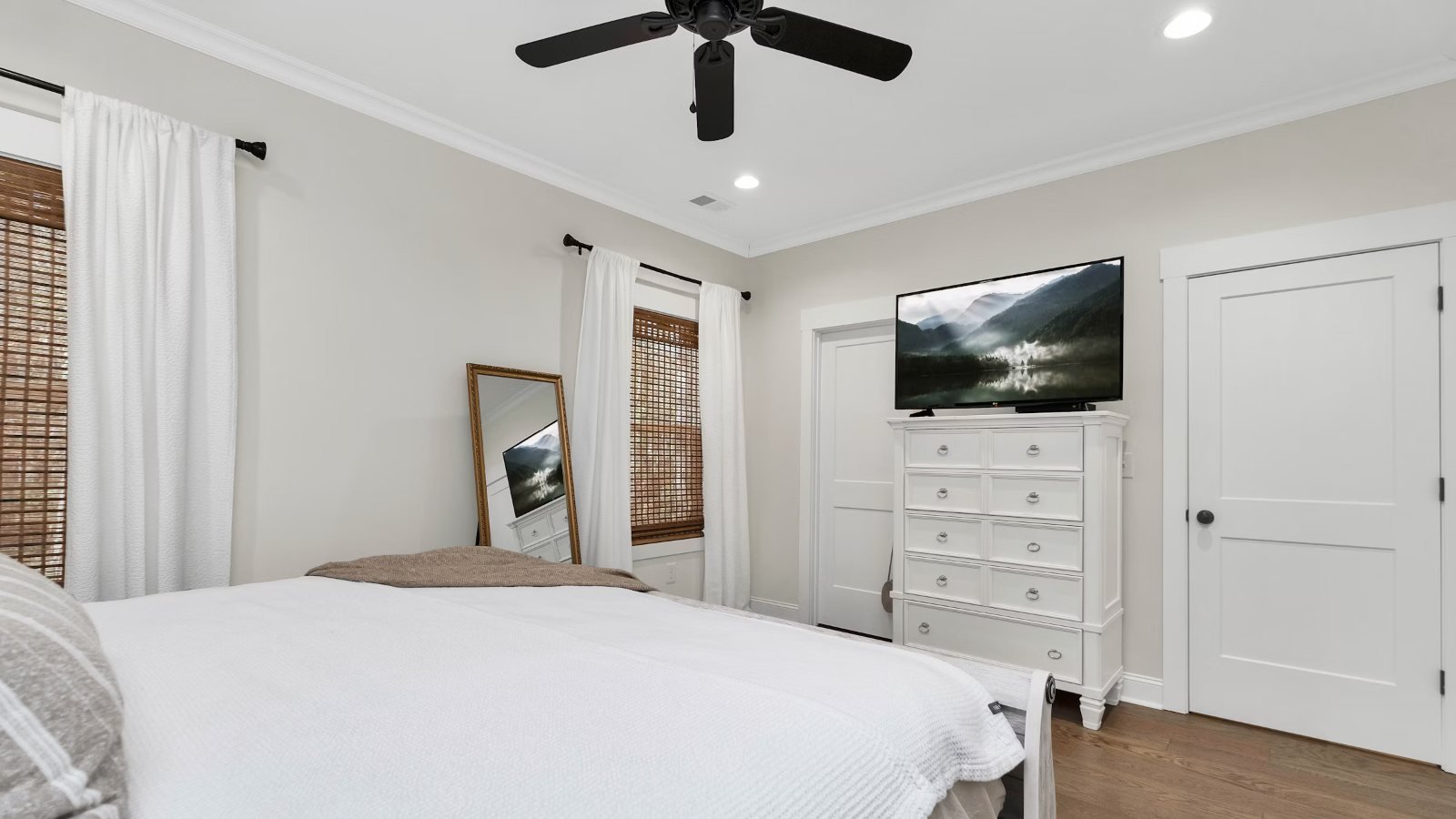
Bedrooms are usually smaller, and you watch reclined, often from 6 to 9 feet away. That points to 50 to 65 inches for most bedrooms. A 12-foot-deep primary bedroom can take a 75-inch TV, but a guest room with the bed 6 feet from the wall is happier with 50 or 55.
| Bed to TV wall | TV size |
|---|---|
| 6 to 7 ft | 50 to 55 in |
| 7 to 8 ft | 55 to 65 in |
| 8 to 10 ft | 65 to 75 in |
Height matters even more in bed, because you’re looking up from a pillow. Our bedroom TV setup guide covers mounting height and the best spots.
What size TV for a living room?
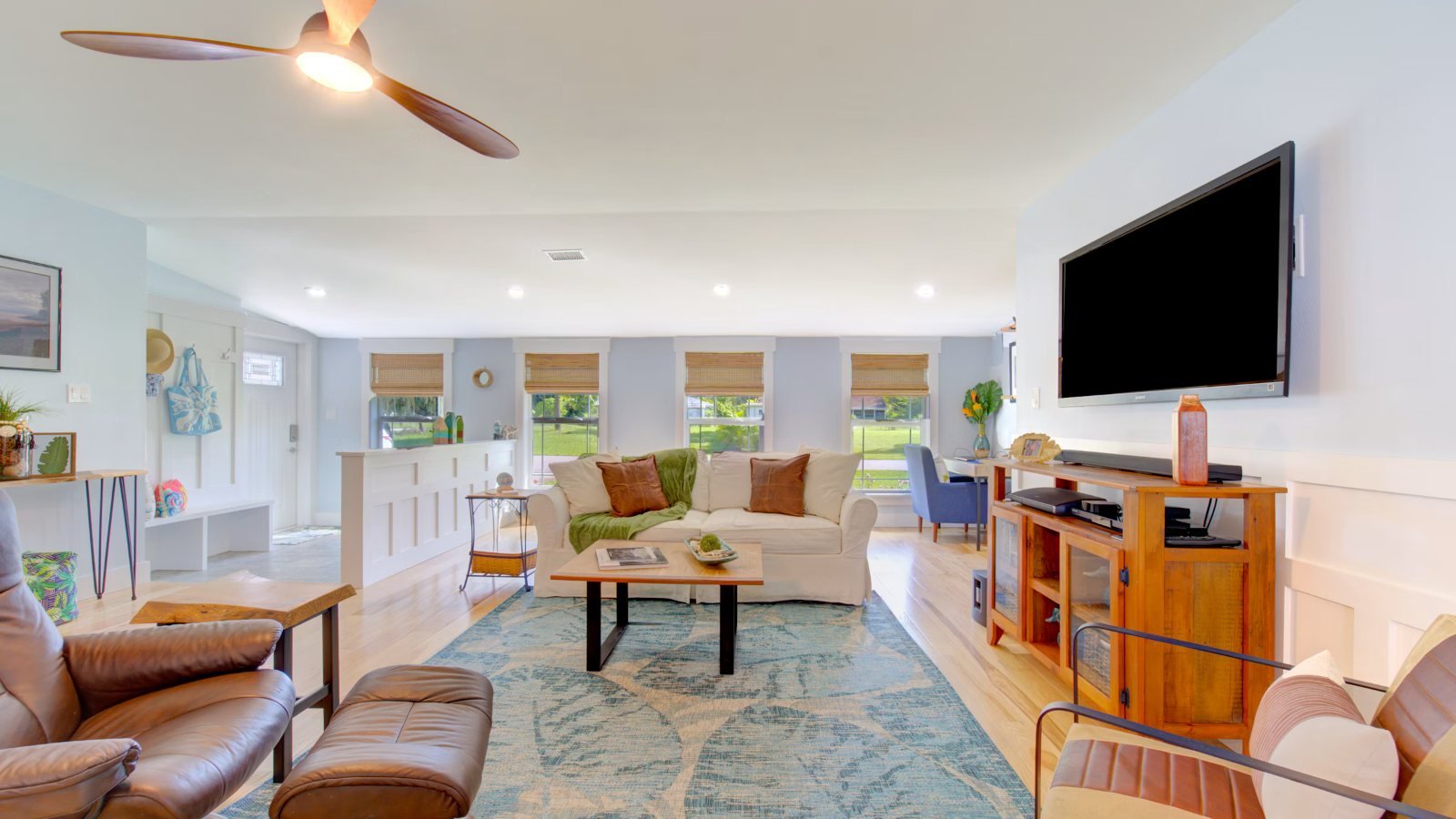
A typical living room layout puts your eyes about 7 to 9 feet from the TV, which is one reason 65 inches is such a popular size. If your sofa is close to the TV wall, read our guide to the best TV for a small room. For larger rooms and open-plan spaces, see the next section.
- Small living room (8 to 10 ft): 55 to 65 inches. See our small living room setup ideas.
- Average living room (10 to 12 ft): 65 to 75 inches. Torn between the two? Our 65 vs 75-inch comparison helps.
- Large or open-plan (12 ft and up): 85 inches or more, or move the seating forward.
What size TV do I need if my room is huge?
Past about 13 feet, the right TV gets very big and very expensive. You have three choices: buy an 85 or 98-inch TV, float the sofa a few feet forward so a 75-inch fits, or switch to a projector. A good projector and a 100-inch screen can cost less than a 98-inch TV. Our projector vs TV guide compares the two in real rooms.
Basement, media room and gaming setups
A dedicated basement or media room is the one place to lean toward the immersive end of the chart. The lights are low, nobody is walking past the screen and you sit there for whole movies. If your seats are 10 feet away, a 75 or 77-inch TV is the natural pick, and an 85-inch still won’t feel too big.
For gaming from the couch, the same distance rule applies, but many players like the screen a little bigger so the HUD and small text stay readable. Our couch gaming setup guide covers seating, latency and the right TV settings.
Renting and can’t drill? A TV stand puts the screen about 15 inches further into the room, so use the “on a stand” column in the chart and pick one size down. Our guide to TV setup without drilling has stands and safe alternatives.
Does resolution change the right TV size for a room?
A little. Resolution decides how close you can sit before you see pixels, not how big the TV should be. With normal eyesight, pixels blend together at about these distances:
| Resolution | Pixels blend from about | 65-inch example |
|---|---|---|
| 1080p | 1.6 times the screen size | about 8 ft 8 in |
| 4K | 0.8 times the screen size | about 4 ft 4 in |
| 8K | 0.4 times the screen size | about 2 ft 2 in |
Because almost every new TV is 4K, picture detail won’t stop you from going bigger in any normal room. An old 1080p TV is different: in a small room, a large 1080p screen can look soft, which is one more reason to upgrade to 4K when you size up.
Two real rooms, worked out
Room 1, an 11 x 13 ft living room with the TV on the 11-foot wall. The room is 13 feet deep, but the sofa sits about 2 feet off the back wall, so the room length to the sofa back is 11 feet. That gives about 9 feet 1 inch from eyes to screen and a range of roughly 68 to 91 inches. A 75 or 77-inch TV is the sweet spot, and an 85-inch fits if the wall is at least 6 and a half feet wide.
Room 2, a 10 x 11 ft bedroom with the TV on a dresser. The bed’s headboard is against the far wall, 11 feet from the TV wall. Propped up on pillows, your head is about 10 feet from that wall, and the dresser pushes the TV about a foot and a half forward, so the distance is about 8 feet 6 inches. That points to 65 inches, or 75 if the wall and budget allow. Wall-mounting the TV instead buys back that foot and a half.
Three things to check besides room length
1. Will it fit on the wall?
A TV is wider than most people expect. A 16:9 TV is about 0.87 times its screen size wide and 0.49 times tall. Leave a few inches on each side, and more if a window or door frame is close.
| TV size | Width | Height (screen only) |
|---|---|---|
| 50 in | about 44 in | about 25 in |
| 55 in | about 48 in | about 27 in |
| 65 in | about 57 in | about 32 in |
| 75 in | about 65 in | about 37 in |
| 85 in | about 74 in | about 42 in |
| 98 in | about 85 in | about 48 in |
Tip: cut a cardboard rectangle (or tape the outline on the wall) at the size you’re considering. It shows the real size better than any chart.
2. Can you mount it at the right height?
Aim the center of the screen near seated eye level, about 42 inches from the floor in most living rooms. Bigger TVs push the bottom edge low, so check there’s room for a soundbar. Our guide on how high to mount a TV has the full rules, and types of TV wall mounts helps if you need tilt or swivel.
3. How bright is the room?
A sunny room changes what TV to buy more than what size. A bigger screen also reflects more windows. If you have lots of daylight, read our picks for the best TV for a bright room before you pick a size.
Is it better to go bigger or smaller?
Many people who upsize find that within a week or two the new TV stops feeling too big, and the old one starts to look tiny. With a 4K TV, you can sit as close as about 0.8 times the screen size before you notice individual pixels, so detail isn’t the limit. Comfort is.
If your room sits between two sizes in the chart, the bigger one is usually the safer choice for movies and sports. Go smaller only if the TV will dominate a small wall, the room is mainly for casual TV, or the budget is tight.
Common mistakes
- Measuring to the front of the sofa. Your eyes are behind the seat edge, often by more than a foot.
- Forgetting the TV stand. A TV on a console sits about 15 inches further into the room than a wall-mounted one.
- Buying by the store feel. TVs look smaller in a big store. Measure at home and trust the numbers.
- Ignoring the wall width. Check the TV’s real width against the space between windows and doors.
How we picked
We built the chart from the viewing-angle guidance used by THX and SMPTE (about 40 and 30 degrees of your field of view), TV makers’ size advice and the typical sofa and mount depths used in our viewing distance guide. Every number comes from that math, and the sources are listed at the end.
FAQ
What size TV for a 10×12 room?
With the TV on the 10-foot wall (12 feet deep), 75 to 85 inches. With the TV on the 12-foot wall (10 feet deep), 65 inches.
What size TV do I need for 8 feet away?
If your eyes are 8 feet from the screen, 65 to 77 inches. If the room is 8 feet long, 50 to 55 inches.
What size TV for a 12×12 room?
A 12-foot-deep room leaves about 10 feet from eyes to screen, so 75 to 85 inches. On a TV stand, 75 inches is the safer pick.
Is 75 inches too big for a bedroom?
Only if the bed is closer than about 8 feet. In larger primary bedrooms, 75 inches works well.
How do I determine TV size for my room?
Measure from the TV wall to the back of the sofa, take off about 2 feet, convert to inches and divide by 1.6 and 1.2.
Is there a TV size for room calculator?
Yes. Our TV size calculator gives sizes from your seating distance in seconds.
Does the rule change for a projector?
No. A 100-inch screen works from about 10 to 13 feet away, the same 1.2 to 1.6 rule.
Related guides
- TV size calculator
- How far should your couch be from the TV?
- How high to mount a TV
- Best TV for a small room
- Bedroom TV setup
Sources: Wikipedia: Optimum HDTV viewing distance · Wikipedia: Visual acuity · Samsung: What size TV should I get · Samsung: before wall mounting your TV · SMPTE EG 18-1994 (withdrawn)