

CouchSetup is reader-supported. When you buy through links on our site, we may earn an affiliate commission at no extra cost to you. As an Amazon Associate, we earn from qualifying purchases. Read our affiliate disclosure
OLED vs QLED vs LED sounds like three totally different TVs, but it’s really two. LED and QLED TVs are both LCD TVs with a backlight behind the screen. QLED just adds a layer of quantum dots for richer color. OLED is the odd one out: every pixel makes its own light, so there’s no backlight at all.
That one difference explains almost everything: why OLED has perfect blacks, why QLED can get brighter, and why a basic LED TV costs the least. Below we break down each type in plain English, compare them side by side and tell you which one fits your room and budget.
Our verdict
Quick answer: OLED has the best picture in a dim room: perfect blacks, wide viewing angles and super fast motion. QLED (especially Mini LED QLED) is brighter, has no burn-in worry and gives you a bigger screen for the money, so it’s the pick for bright rooms. Basic LED is the cheapest and fine for a guest room or kitchen, but it looks flat next to the other two.
Top picks at a glance
Best OLED
LG C6 OLED
Dark or mixed-light living rooms, movies and gaming
$$$ PremiumBest value OLED
LG B6 OLED
Bedrooms, dark rooms and OLED on a tighter budget
$$ Mid-rangeBest QLED
TCL QM7L SQD Mini LED
Bright living rooms and big screens on a mid-range budget
$$ Mid-rangeWhat is the difference between LED, QLED and OLED?
All three names describe how the screen makes light and color. Here’s the short version, from the cheapest to the most expensive.
LED TV (really an LED-backlit LCD)
A standard LED TV has a row or grid of white LEDs behind an LCD panel. The LCD layer opens and closes tiny shutters to let light through or block it. The problem is that the shutters never block light completely, so black scenes look dark gray, especially in a dark room. On the plus side, LED TVs are cheap, last a long time and come in every size.
QLED TV (an LED TV with quantum dots)
A QLED TV is still an LCD TV with a backlight. The difference is a thin film of quantum dots, tiny particles that glow very pure red and green when blue LED light hits them. That gives you more vivid, more accurate colors and usually more brightness than a basic LED TV. Samsung started using the QLED name in 2017, and brands like TCL and Hisense use it too. Sony calls its version Triluminos.
Many QLED TVs now use a Mini LED backlight: thousands of tiny LEDs split into hundreds or thousands of dimming zones. That lets the TV turn parts of the backlight down in dark areas, which brings blacks much closer to OLED. Samsung’s Mini LED models are called Neo QLED, and TCL’s QM series and Hisense’s U series are Mini LED QLEDs too.
OLED TV (self-lit pixels)
OLED stands for organic light-emitting diode. Each of the millions of pixels makes its own light and can switch fully off. No backlight means true black, an infinite contrast ratio, no glow around bright objects and great viewing angles. LG’s OLEDs use white OLED pixels with color filters (often called WOLED). Samsung and Sony also sell QD-OLED TVs, which use a blue OLED layer plus quantum dots for even richer color.
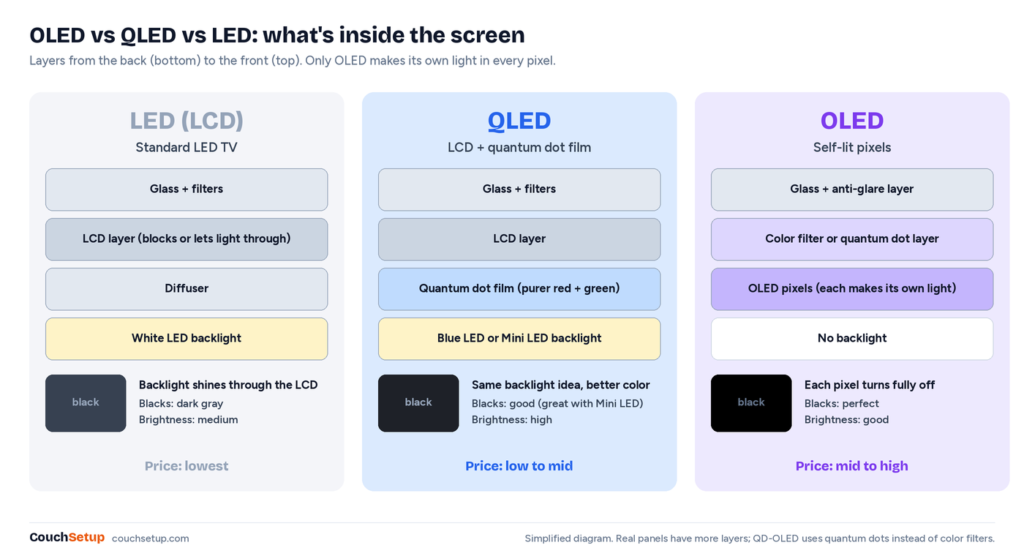
Is QLED the same as OLED? No, and the names are confusing on purpose. QLED is an LCD TV with quantum dots. The “Q” doesn’t make it an OLED. QD-OLED is the only type that mixes the two ideas, and it’s an OLED.
OLED vs QLED vs LED comparison table
Here’s how the three types usually stack up. Real TVs vary a lot by model and price, so treat this as the typical pattern, not a rule for every set.
| Feature | LED (LCD) | QLED / Mini LED | OLED |
|---|---|---|---|
| How it makes light | White LED backlight | Blue LED or Mini LED backlight + quantum dots | Each pixel lights itself |
| Black levels | Dark gray in a dark room | Good; very good with Mini LED | Perfect black |
| Contrast | Low to medium | High with local dimming | Infinite |
| Brightness | Medium | Highest | Good, a bit lower on average |
| Color | OK | Rich and bright | Rich, best in dark scenes |
| Viewing angle | Often narrow | Narrow to OK | Wide |
| Blooming / halos | Some glow | Some halos around bright objects | None |
| Motion and response time | Slower | Good | Fastest |
| Burn-in risk | None | None | Low, but possible with static images |
| Typical price | $ (lowest) | $ to $$ | $$ to $$$ |
QLED vs OLED: which has the better picture?
This is the matchup most buyers are really weighing. RTINGS compared Samsung’s QN90F (a Mini LED QLED) with LG’s G5 OLED in a March 2026 update, and the results show the classic trade-offs:
- Contrast: the OLED’s contrast is infinite because pixels turn fully off. The QLED’s is very high for an LCD, but it still shows halos around bright objects like subtitles on a black background.
- Brightness: close at the top end, but RTINGS says QLEDs are, on average, a little brighter than WOLED TVs. Budget OLEDs are dimmer than flagship ones like the G5.
- Color: the OLED covered more of the wide BT.2020 color space in their measurements.
- Uniformity and motion: OLED wins both. Its response time is much faster, which keeps fast sports and games crisp.
- Lifespan: RTINGS calls it a tie. OLED can get burn-in from static images; QLEDs can lose color over time as quantum dots age.
- Price: OLEDs start higher and cost more on average.
So OLED has the better picture in most ways, while QLED wins on brightness, price and peace of mind. If you’re torn between a premium OLED and a premium Mini LED QLED, our OLED vs Mini LED guide goes deeper on those two.
LED vs QLED: is QLED better than LED?
Yes, in nearly every way that you can see. Both are LCD TVs, but the quantum dot layer gives QLED brighter, more saturated color, and most QLEDs also have better backlights and better HDR. The price gap has gotten small: a budget QLED often costs only a little more than a plain LED TV of the same size.
A basic LED TV still makes sense when price is the only thing that matters: a kitchen, a garage, a kids’ room or a guest bedroom that gets a few hours of TV a week. For your main TV, a QLED with Mini LED is the better buy.
OLED vs LED: is the jump worth it?
It’s the biggest jump of the three. Next to a basic LED TV, an OLED looks like a different class of screen: blacks are black, dark movie scenes show detail instead of gray mush, and the picture holds up from the side of the couch. The catch is price. OLED usually costs two to three times as much as an LED TV of the same size, and it doesn’t come in the very largest sizes for cheap.
Which is best for your room?
Bright living room with lots of windows
Pick a Mini LED QLED. It gets brighter, fights glare better and costs less at big sizes. OLEDs have improved a lot, but a sunny room is still where QLED shines. See our picks for the best TV for a bright room.
Dark room, basement or bedroom
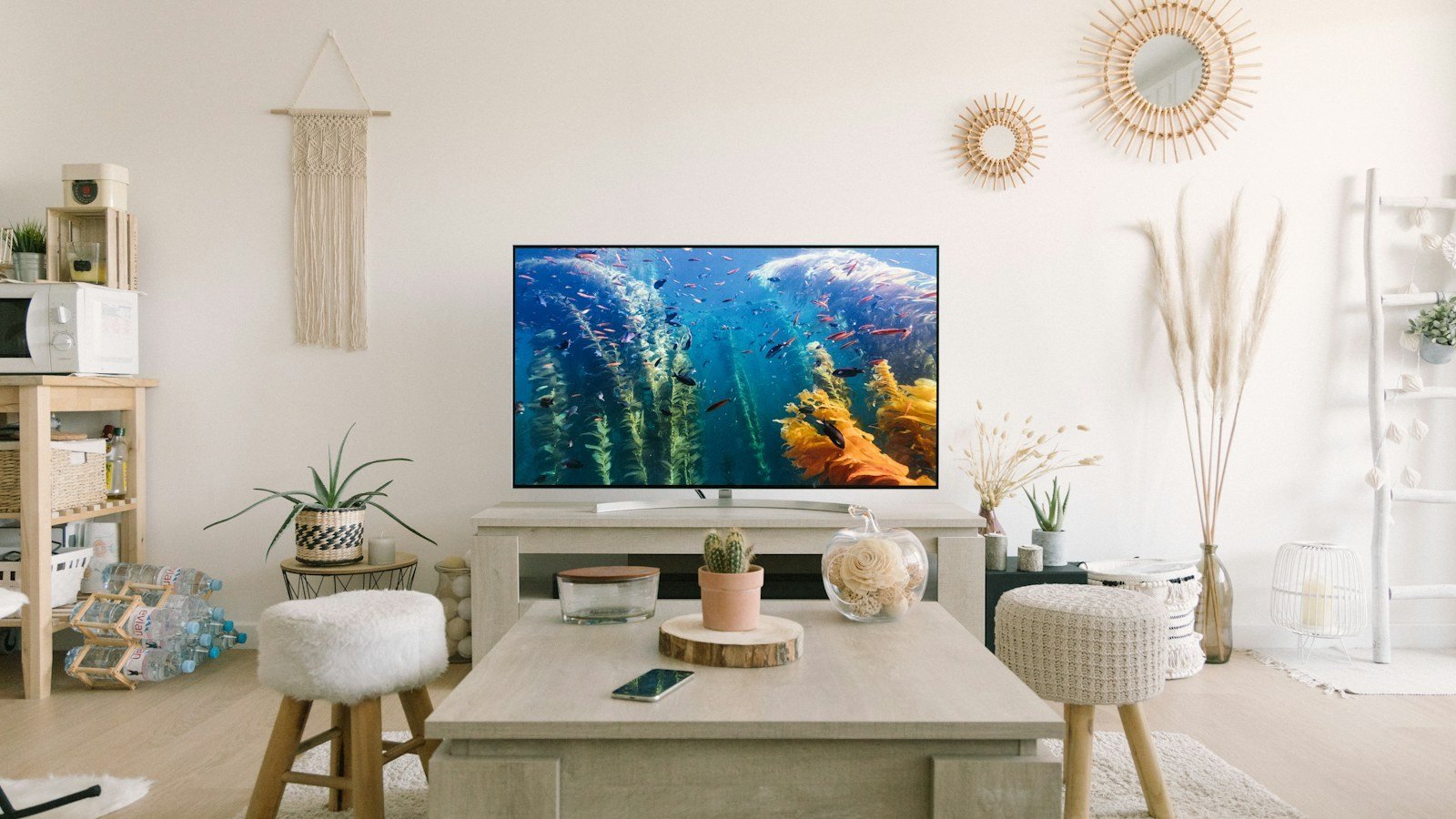
Pick OLED. With the lights off, perfect black and no blooming make movies look the way they were meant to. A budget OLED like the LG B6 is a great bedroom TV. Our best TV for a small room guide has more ideas.
Gaming
Both work well in 2026. OLED has the fastest response time and great HDR in a dark room. QLED is the safer pick if you play the same game for hours with a static HUD, since it can’t burn in. Our best TV for PS5 and Xbox guide compares the top gaming models.
Sports and lots of cable news
Lean QLED if the TV runs all day on channels with fixed logos and tickers. Modern OLEDs have screen-saving tricks, and most people never see burn-in, but RTINGS still suggests QLED for people who watch the same channels nonstop.
Tight budget
Pick a budget Mini LED QLED over a basic LED. You get far better brightness and color for a small step up in price.
Our OLED, QLED and LED picks for 2026
These are the models we’d shortlist for each type. Prices change often, so the $ signs show the rough price tier, not an exact price. Full details are in our TV buying guide.
LG C6 OLED
Best for Dark or mixed-light living rooms, movies and gaming
- OLED: perfect blacks and no blooming
- Up to 165Hz with four HDMI 2.1 ports
- Dolby Vision and very low input lag
- VRR, ALLM and HGiG HDR gaming
Prices change often, so check today’s price on Amazon.
LG B6 OLED
Best for Bedrooms, dark rooms and OLED on a tighter budget
- Same perfect blacks and wide viewing angles
- Four HDMI 2.1 ports, 4K 120Hz with VRR
- 695 nits HDR peak in Tom’s Guide’s test
- Sizes from 48 to 83 inches
Prices change often, so check today’s price on Amazon.
TCL QM7L SQD Mini LED
Best for Bright living rooms and big screens on a mid-range budget
- 2,270 nits HDR peak in Tom’s Guide’s test
- Up to 2,100+ local dimming zones
- Anti-reflective HVA panel
- 4K 144Hz on two HDMI 2.1 ports
- 55 to 98 inches
Prices change often, so check today’s price on Amazon.
Hisense U7SG Mini LED
Best for Large, bright living rooms, sports and gaming
- About 2,867 nits HDR peak in Tom’s Guide’s test
- 165Hz native refresh rate
- Four HDMI 2.1 ports
- Sizes from 55 to 100 inches
Prices change often, so check today’s price on Amazon.
Hisense U6SF Pro Mini LED
Best for Bright rooms on a tight budget, bedrooms and first apartments
- 1,265 nits HDR peak in Tom’s Guide’s test
- Anti-reflection, glare-free screen coating
- Native 144Hz panel
- Fire TV with Alexa+ built in
- 55 to 100 inches
Prices change often, so check today’s price on Amazon.
Want the details? Read our LG C6 review, LG B6 review, TCL QM7L review, Hisense U7SG review and Hisense U6 review.
Common myths about OLED, QLED and LED
- “QLED is a kind of OLED.” It isn’t. QLED is an LCD TV with a quantum dot layer and a backlight.
- “OLED burns in after a year.” Not for normal use. Modern OLEDs shift pixels and refresh the panel to reduce it. The risk is real mainly with the same static image for many hours a day.
- “LED TVs use old technology.” Every LCD TV, including QLED and Mini LED, uses LEDs. “LED TV” on a box usually means a basic model without quantum dots or local dimming.
- “Brighter is always better.” Only in bright rooms. In a dark room, black level and contrast matter more than peak brightness.
Getting the best picture from any type
Whatever you buy, the default store mode looks too blue and too sharp. Switch to Filmmaker, Movie or Calibrated mode, turn off motion smoothing for movies, and check our best TV picture settings guide. Still not sure what size to get? Our guide on what size TV for your room has a chart by room length.
How we picked
We didn’t put these TVs side by side in our own lab. We based this guide on published measurements from RTINGS, the TV makers’ own specs, and lab results from Tom’s Guide, then matched each panel type to real rooms and budgets. Our product picks are the same models we recommend in our TV buying guide.
FAQ
Which is better: OLED, QLED or LED?
OLED has the best overall picture, especially in a dark room. QLED is brighter, can’t burn in and costs less at big sizes, so it’s better for bright rooms. Basic LED is the cheapest but has the weakest picture.
Is QLED better than LED?
Yes. QLED is an LED TV with a quantum dot layer, so it has richer color and usually better brightness and HDR for only a little more money.
Is QLED the same as OLED?
No. QLED is an LCD TV with a backlight and quantum dots. OLED has no backlight because each pixel makes its own light.
Does QLED have burn-in?
No. QLED TVs can’t get burn-in like OLED. Their quantum dots can slowly lose color over many years, but that’s a different issue.
Is OLED worth the extra money?
If you watch a lot of movies in a dim room, usually yes. If your room is bright or the TV is on all day with news or sports, a Mini LED QLED is often the smarter buy.
What’s the difference between QD-OLED and QLED?
QD-OLED is an OLED TV that uses quantum dots to make its colors. QLED is an LCD TV that uses quantum dots with a backlight. They only share the quantum dots.
Which TV type lasts the longest?
All three last many years with normal use. RTINGS rates OLED and QLED as a tie on longevity: OLED can burn in with static content, while QLED’s quantum dots can fade over time.
Related guides
- OLED vs Mini LED: which TV is better for your room?
- TV buying guide
- Best TV for a bright room
- Best TV for PS5 and Xbox
- What size TV for my room?
Sources: RTINGS: QLED vs OLED · Wikipedia: Quantum dot display · Wikipedia: OLED · LG: OLED TVs · TCL: QLED vs OLED