
CouchSetup is reader-supported. When you buy through links on our site, we may earn an affiliate commission at no extra cost to you. As an Amazon Associate, we earn from qualifying purchases. Read our affiliate disclosure
This Hisense U7SG review comes down to one question: do you want the brightest, best-connected big screen you can get without paying flagship money? If yes, the U7SG is one of the best mid-range TVs of 2026. It gets very bright, has four full-speed HDMI 2.1 ports, sounds better than almost any TV at its price and comes in sizes up to 116 inches. What it doesn’t do as well is deep, inky blacks, and its colors are a step behind its closest rival, the TCL QM7L.
Hisense U7SG Mini-LED
8.5/10 CouchSetup score
Best for Large, bright living rooms, sports and multi-console gaming
- About 2,867 nits HDR peak in Tom’s Guide’s test
- Native 165Hz panel, four HDMI 2.1 ports
- Anti-glare screen
- 2.1.2-channel, 50W Dolby Atmos speakers
- Sizes from 55 to 116 inches
Prices change often, so check today’s price on Amazon.
Our verdict
Short verdict (8.5/10): a bright, fast, great-sounding Mini LED TV with every gaming port you need, at a mid-range price. Pick it over the TCL QM7L if you have two consoles and a soundbar, want 100 inches or more, or don’t want to buy a soundbar. Pick the QM7L for richer color, or an OLED if you mostly watch movies in the dark.
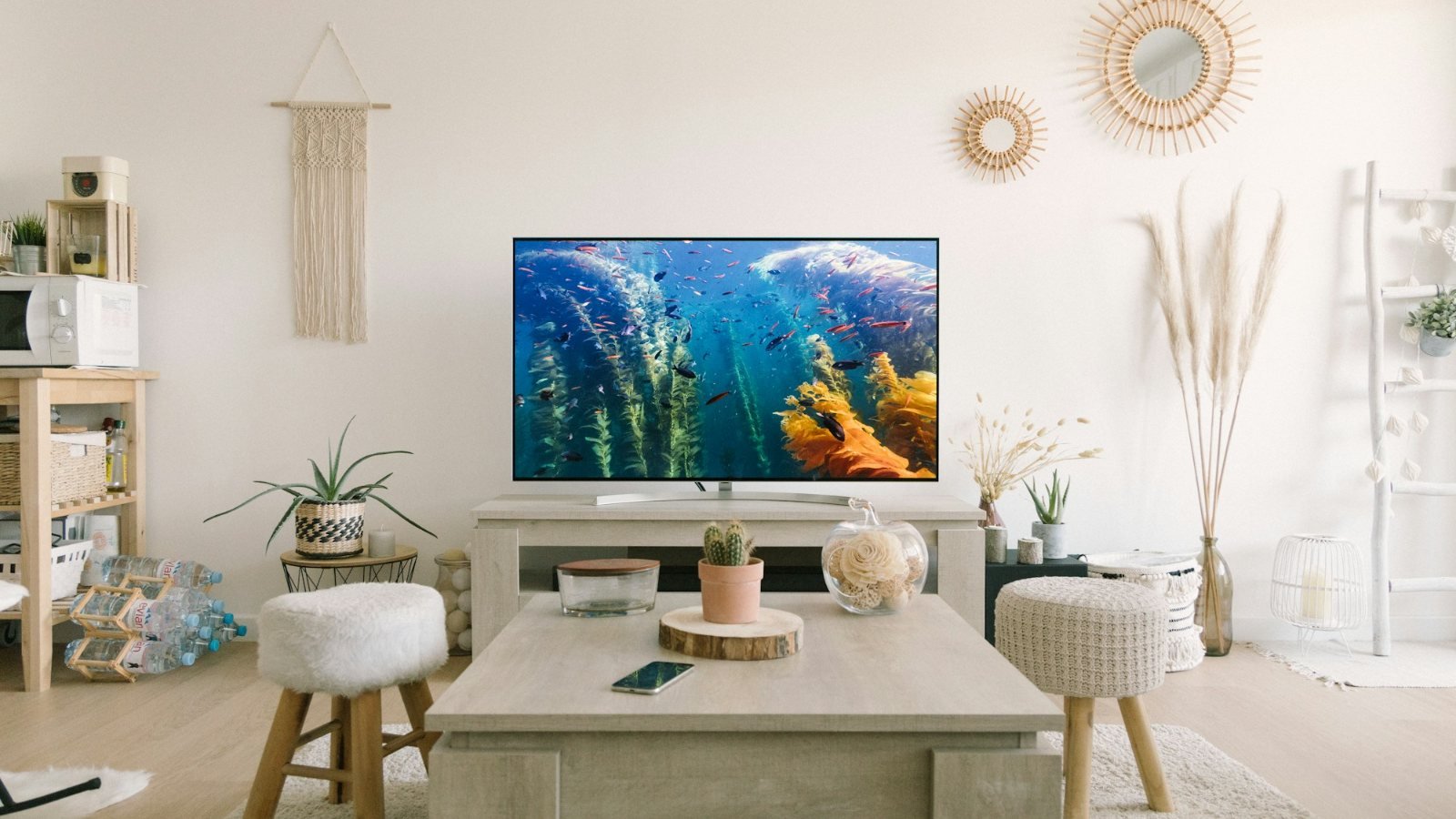
Hisense U7SG review: key specs
| Spec | Hisense U7SG (2026) |
|---|---|
| Sizes | 55, 65, 75, 85, 100 and 116 in |
| Panel | 4K Mini LED (Hi-QLED Mini LED Pro) with local dimming, anti-glare screen |
| Rated peak | Up to 3,000 nits (Hisense) |
| Refresh | Native 165Hz; Game Booster mode up to 330Hz at lower resolutions |
| HDMI | 4 × HDMI 2.1; eARC on HDMI 3 |
| HDR | Dolby Vision IQ, HDR10+, HDR10, HLG |
| Gaming | VRR, ALLM, AMD FreeSync Premium Pro |
| Sound | 2.1.2 channels, 50W (60W on the 100-inch), Dolby Atmos, DTS Virtual:X |
| Platform | Google TV with Gemini, Wi-Fi 6E, ATSC 3.0 tuner |
How bright is the Hisense U7SG?
Very. Tom’s Guide measured about 2,867 nits on a 10% HDR window, well above the 1,684-nit average of the newer 65-inch LCDs they’ve measured, and their lab also recorded close to 800 nits on a full white screen. That’s the kind of headroom that makes sunsets, stadium lights and specular highlights pop even with the curtains open.
The anti-glare screen matters just as much in a sunny room. Hisense barely mentions it in its marketing, but reviewers noticed: Android Headlines called it great even in bright rooms, and Audioholics found it held its contrast in midday sunlight. If your TV faces windows, it’s one of the strongest picks in our best TVs for bright rooms guide.
SDR is a different story in the accurate Filmmaker mode: Tom’s Guide measured only about 185 nits there. That’s fine at night, but for daytime cable or YouTube you’ll want a brighter preset like Standard or a calibrated Day mode.
Picture quality: color, contrast and blooming
Color is good rather than class-leading. Tom’s Guide measured 97.31% of the UHD-P3 color space, essentially level with the QM7L, but only 82.75% of the wider Rec. 2020 space against the QM7L’s 90.28%, and a Delta-E of 3.0 against the QM7L’s 2.6. In plain terms: the U7SG looks rich and natural, but the TCL squeezes out a little more saturation in HDR.
Blacks are where reviewers disagree. Tom’s Guide listed weak black levels as its biggest complaint, with shadows that looked a little gray next to rivals. Audioholics was much happier with the contrast, and RTINGS found less haloing around bright objects than on the cheaper U6. The likely truth: it’s a big step up from a basic LED TV and excellent for a bright room, but if you watch dark movies with the lights off, an OLED will look noticeably deeper.
Viewing angle
The larger sizes use a VA-type panel, which is what gives LCD TVs their contrast, but it also means colors and contrast fade when you sit well off to the side. Hisense’s launch specs list the 55-inch with an IPS-type panel instead, which trades some contrast for wider angles. On a wide sectional, the seats at the ends will see a slightly washed-out picture on the bigger sizes.
Gaming: four HDMI 2.1 ports and 165Hz
This is the U7SG’s trump card. All four HDMI ports are full-speed HDMI 2.1, so a PS5, an Xbox Series X, a gaming PC and a soundbar can all be plugged in without giving anything up. Consoles run at 4K 120Hz, and a PC can push the native 165Hz panel, with VRR, ALLM and FreeSync Premium Pro. Tom’s Guide measured 9.8 ms of input lag in Game mode, which is effectively the same as the QM7L’s 9.4 ms. See how it compares with other gaming picks in our best TVs for PS5 and Xbox.
The 330Hz Game Booster mode only works at lower resolutions, and current consoles top out at 120Hz, so it’s a PC feature at best. Don’t pay for it if you only play on a PlayStation or Xbox.
Sound: you may not need a soundbar
Most thin TVs sound thin. The U7SG is the exception. It has a 2.1.2-channel system with up-firing drivers and a built-in woofer, rated at 50W, and the reviewers were unusually positive. Tom’s Guide called it surprisingly powerful, Android Headlines skipped a soundbar altogether, and Audioholics compared it with a $200 to $300 soundbar. Tom’s Guide did find the default bass boost a bit heavy on music, so turn it down a notch. For a bigger room, you’ll still get more from a real soundbar; start with our best soundbars under $300.
Google TV, remote and setup
Google TV has every major app, free live channels and Gemini voice search, and Wi-Fi 6E keeps 4K streams steady. The catch is the home screen: it’s full of promoted content, and Tom’s Guide also flagged nosy default privacy settings, so take two minutes in the settings to switch off what you don’t want shared. Reviewers split on the remote: Tom’s Guide found it chunky, while Audioholics liked its backlight and well-spaced buttons.
Setup is simple, but the feet sit near the edges on most sizes, so measure your furniture first. Our TV stands for 65-inch TVs guide covers stand width, and how high to mount a TV helps if you wall-mount it.
What the reviews don’t tell you
“Up to 3,000 dimming zones” is the biggest size
Some retail listings quote up to 3,000 local dimming zones. That’s the series maximum on the largest sizes; the 65-inch has far fewer. More zones mean less glow around subtitles, so the bigger U7SGs will usually look a little cleaner in dark scenes than the 55 and 65.
Check the panel when it arrives
Owner reports in the months after launch are mostly positive about brightness and the matte screen, but a few mention uneven patches on plain-color screens (the dirty-screen effect common to big LCD panels), and the odd dead pixel. These are individual reports, not a known defect rate. Still, during your return window, look at a plain gray or white screen and a slow pan across a sports field.
U7SG vs U7SF
Hisense also sells a U7SF. It’s the same series with Fire TV instead of Google TV, sold through some retailers. Check which smart system you’re getting before you order.
Hisense U7SG vs Hisense U6SF Pro
The cheaper U6SF Pro is the other Hisense people compare it with. The U6 is a great budget buy, but the U7SG is the bigger step up than the names suggest. Tom’s Guide measured about 1,265 nits of HDR on the U6SF Pro against about 2,867 on the U7SG, so highlights and daytime viewing are in a different league.
The U7SG also has four HDMI 2.1 ports instead of two, a faster 165Hz panel instead of 144Hz, much stronger 2.1.2 speakers and Google TV instead of Fire TV. If your budget allows, the U7SG is the better long-term TV; if it doesn’t, our Hisense U6 review explains what you still get for less.
Hisense U7SG vs TCL QM7L
These two are the mid-range TVs most people cross-shop, and Tom’s Guide gave them the same overall score after testing both.
| Feature | Hisense U7SG | TCL QM7L |
|---|---|---|
| HDR peak, 10% window | about 2,867 nits | about 2,270 nits |
| SDR, accurate mode | about 185 nits | about 196 nits |
| Rec. 2020 color | 82.75% | 90.28% |
| Delta-E | 3.0 | 2.6 |
| Input lag | 9.8 ms | 9.4 ms |
| HDMI 2.1 ports | 4, up to 165Hz | 2, up to 144Hz |
| Built-in sound | 2.1.2, 50W | Basic |
| Largest size | 116 in | 98 in |
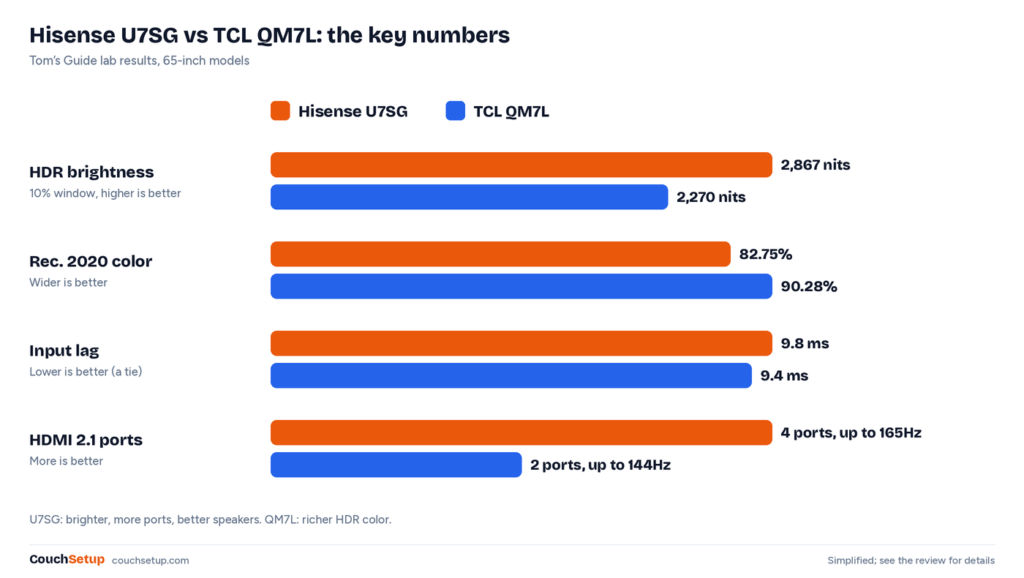
Choose the U7SG for more ports, better speakers or a giant screen. Choose the QM7L for richer HDR color. Full detail in our TCL QM7L review, and if you’re still deciding between technologies, read OLED vs Mini LED.
Which size Hisense U7SG should you buy?
The U7SG comes in more sizes than almost any rival, from 55 to 116 inches. Use your seating distance to pick, then check the wall or stand width.
| Eyes to screen | U7SG size | Note |
|---|---|---|
| 6 to 7 ft | 55 in | The 55 uses a wider-angle panel, good for a corner or bedroom |
| 7 to 9 ft | 65 in | Best value for most living rooms |
| 9 to 10 ft | 75 in | The sweet spot for sports and gaming |
| 10 to 12 ft | 85 in | Bigger sizes usually get more dimming zones |
| 12 ft and up | 100 or 116 in | A bright alternative to a projector |
Remember the feet: on most sizes they sit near the edges, so a 75-inch needs furniture about as wide as the screen. The 100 and 116-inch models are heavy enough that wall mounting is usually easier. Our TV size for your room chart has more detail.
Best picture settings for the Hisense U7SG
The U7SG looks good out of the box, but a few changes help. At night, use Filmmaker mode or Dolby Vision Dark for the most accurate picture. During the day, switch to Standard or Dolby Vision Bright, because Filmmaker mode is fairly dim in SDR.
Leave local dimming on High for HDR, and turn motion smoothing off for films so they don’t get the soap opera look; our guide to turning off motion smoothing shows where it hides. For games, enable Game mode and let ALLM switch it on automatically. On the sound side, try lowering the bass boost a step if music sounds boomy. More tips in our best TV picture settings guide.
Hisense U7SG review verdict: how we scored it
| Category | Score | Why |
|---|---|---|
| Brightness and HDR | 9.5 | About 2,867 nits and an anti-glare screen |
| Contrast and blacks | 7.5 | Good for an LCD, but behind OLED and some rivals |
| Color | 8.0 | Rich, but narrower HDR color than the TCL QM7L |
| Gaming | 9.5 | Four HDMI 2.1 ports, 165Hz, VRR, about 9.8 ms lag |
| Sound | 9.0 | 2.1.2 speakers that rival a cheap soundbar |
| Smart features | 7.5 | Google TV is complete but full of ads |
What we liked
- Very bright HDR: about 2,867 nits in Tom’s Guide’s test
- Anti-glare screen holds up in sunny rooms
- Four HDMI 2.1 ports and a native 165Hz panel
- Built-in 2.1.2 speakers that rival a cheap soundbar
- Huge size range, up to 116 inches
What we didn’t like
- Black levels behind OLED and some rivals
- Narrower HDR color than the TCL QM7L
- Dim SDR in Filmmaker mode
- Ad-heavy home screen and nosy default privacy settings
- Off-angle picture fades on the VA-panel sizes
Who should buy the Hisense U7SG?
- Buy it for a bright living room, daytime sports, a 75-inch or bigger screen, two consoles plus a soundbar, or if you’d rather skip a soundbar entirely.
- Skip it for dark-room movie nights (an OLED like the LG C6 looks deeper), the richest HDR color (TCL QM7L), a very wide seating area, or a tight budget (the Hisense U6 costs less).
TCL QM7L SQD Mini-LED
Best for Bright rooms and richer HDR color
- About 2,270 nits HDR in Tom’s Guide’s test
- 90% Rec. 2020 color
- Google TV
Prices change often, so check today’s price on Amazon.
Not sure what size to get? Our TV size for your room chart and the TV buying guide walk through it.
How we picked
We gathered the published measurements and expert reviews (Tom’s Guide’s full review and its U7SG vs QM7L comparison, Audioholics, Android Headlines and The Verge), checked the specs against Hisense’s launch details, and read owner reports from the months after release. Where reviewers disagreed, as they did on black levels, we say so. The 8.5/10 score weighs brightness, gaming and sound against the weaker blacks and color. Every source is listed at the end.
FAQ
Is the Hisense U7SG a good TV?
Yes. It’s one of the best mid-range TVs of 2026 for bright rooms, gaming and sound, with weaker black levels than OLED as the main trade-off.
Is the Hisense U7SG better than the TCL QM7L?
It’s brighter, has four HDMI 2.1 ports instead of two and much better speakers. The QM7L has richer HDR color. Tom’s Guide scored them the same.
Is the Hisense U7SG good for gaming?
Yes. Four HDMI 2.1 ports, a native 165Hz panel, VRR and about 9.8 ms of input lag.
Does the Hisense U7SG have Dolby Vision?
Yes, Dolby Vision IQ, plus HDR10+, HDR10 and HLG.
Does the Hisense U7SG need a soundbar?
Less than most TVs. Its 2.1.2-channel speakers are strong for the price, but a good soundbar still helps in a large room.
What sizes does the Hisense U7SG come in?
55, 65, 75, 85, 100 and 116 inches.
Related guides
- Best TVs for wide viewing angles
- TCL QM7L review
- Best TVs for bright rooms
- Best TVs for PS5 and Xbox
- Hisense U6 review
Sources: Tom’s Guide Hisense U7SG review · Tom’s Guide: Hisense U7SG vs TCL QM7L · Audioholics Hisense U7SG review · Android Headlines: U7SG first impressions · Notebookcheck: Hisense U7SG launch specs · RTINGS Hisense U7SG review